



For many U.S. households, drying performance is the most frustrating part of using a dishwasher. Dishes come out clean, yet plastics are still wet, glasses hold water spots, and cookware often needs towel-drying before it can be put away. Naturally, this leads to the same assumption: the dishwasher isn’t drying properly.
However, in most cases, the issue isn’t a defect—it’s the drying method itself.
If your dishes come out clean but still look wet, it’s often connected to how water circulates and how the load is positioned inside the tub. This breakdown of why my dishwasher doesn’t clean well explains how loading habits affect performance in ways most people overlook.
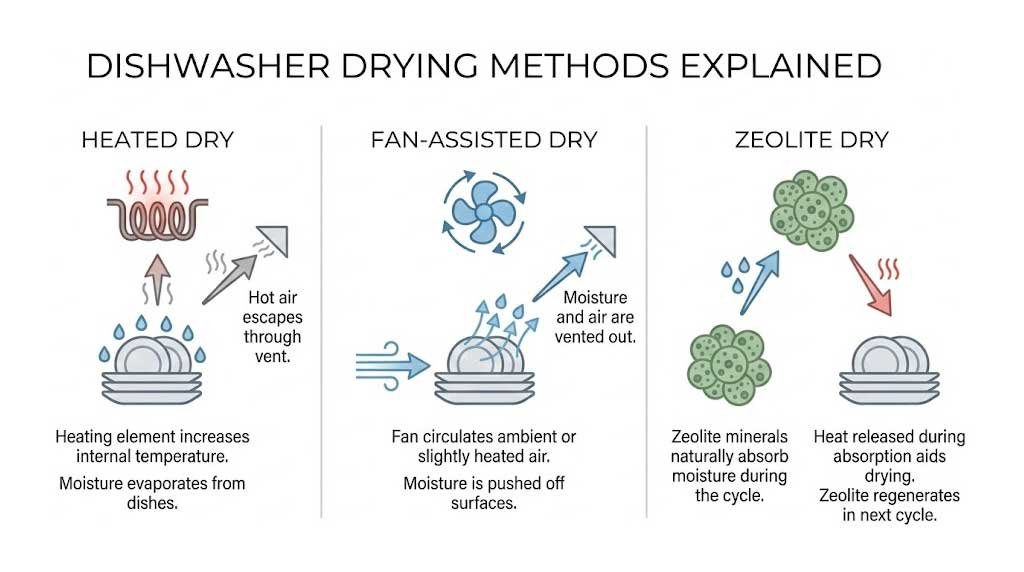
In practice, not all dishwashers dry dishes the same way. Some rely on traditional heating elements, others use airflow and condensation, and a growing number of premium models use advanced materials like zeolite to absorb moisture. Because each method works differently, drying results vary widely—especially when it comes to plastics, energy use, and cycle time.
More importantly, drying performance has become increasingly tied to energy efficiency. As dishwashers use less water and lower temperatures, manufacturers have adopted different drying technologies to balance performance and efficiency. As a result, understanding how a dishwasher dries is just as important as knowing how well it washes.
This guide explains the three main dishwasher drying methods—heated dry, fan-assisted drying, and zeolite drying—and breaks down how each one works, where it excels, and which type of household it’s best suited for.
Why Dishwasher Drying Performance Varies So Much
Drying performance isn’t random. It’s the direct result of heat, airflow, and moisture management working together—or failing to do so.
For a quick refresher on spray arms, circulation, and heat management, see how a dishwasher actually works.
The key factor to understand is this: dishwashers don’t “blow-dry” dishes the way people expect. Instead, they rely on a combination of evaporation, condensation, and air movement. When any part of that process is limited, drying suffers.
Why some dishwashers leave plastics wet
Plastic items are the hardest to dry because they don’t retain heat well. Unlike ceramic or glass, plastic cools quickly, which prevents water from evaporating effectively. As a result, even dishwashers with strong washing performance can struggle to dry plastic containers and lids.
This is why many users notice that plates and glasses come out dry, while plastics remain wet—sometimes completely.
Drying methods that rely purely on residual heat tend to perform poorly here. Methods that actively manage moisture or airflow perform significantly better.
The role of heat, airflow, and condensation
Effective drying depends on three elements working together:
- Heat, which helps water evaporate
- Airflow, which carries moisture away
- Condensation surfaces, where moisture can collect and drain
Traditional dishwashers emphasize heat. Newer designs focus more on airflow and controlled condensation. Advanced systems combine all three.
Because manufacturers prioritize different elements, drying performance varies not just by brand, but by drying technology. This is why two dishwashers with similar wash performance can produce very different drying results.
Heated Dry Explained (Traditional Heating Element)
Heated dry is the most familiar and widely used dishwasher drying method in the U.S. For decades, it was the default solution—and in many models, it still is.
How heated drying works
Dishwashers with heated dry use an exposed heating element at the bottom of the tub. After the final rinse, this element heats the air inside the dishwasher, raising the internal temperature and encouraging moisture to evaporate from dishes.
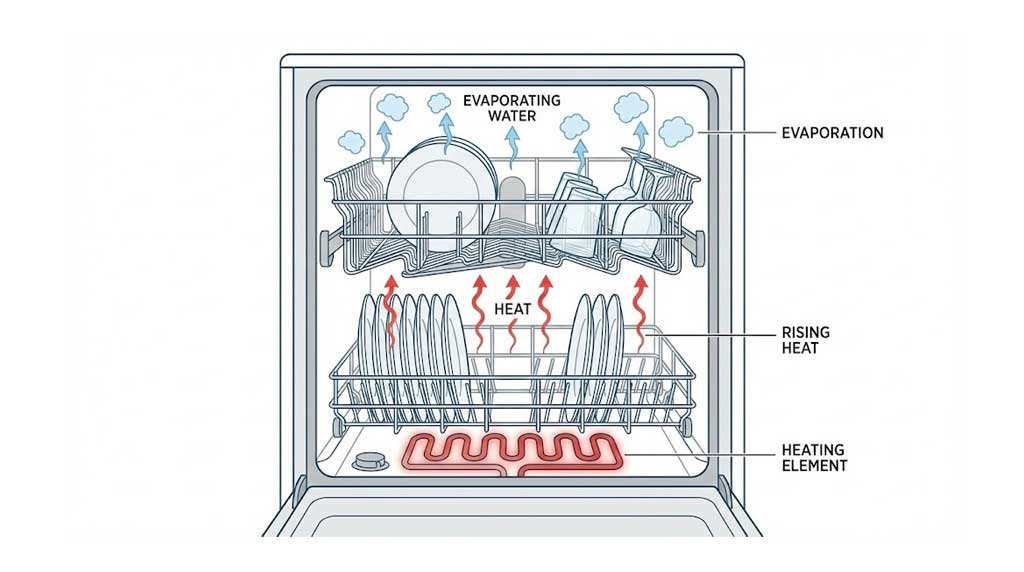
In simple terms, it works much like an oven set to low heat.
Because of this direct heat, water evaporates quickly from hard surfaces like plates, bowls, and glassware. As a result, heated dry often produces visibly dry dishes at the end of the cycle—at least on non-plastic items.
Pros of heated dry
Heated drying offers a few clear advantages:
- reliable drying for ceramics and glass
- short drying times
- simple, proven technology
For households that value speed and don’t use many plastic items, heated dry can still feel effective.
Cons of heated dry
However, heated dry comes with trade-offs.
Because the heating element runs at high temperatures, it uses more electricity than other drying methods. This not only increases energy consumption but can also damage heat-sensitive plastics over time.
In addition, many modern dishwashers reduce or disable heated dry by default to meet energy efficiency standards. As a result, users may experience weaker drying unless the option is manually enabled—often with a noticeable increase in energy use.
Who heated dry is best for
Heated dry works best for:
- households that prioritize fast drying
- loads with minimal plastic items
- users who don’t mind higher energy consumption
For energy-conscious buyers or homes with lots of plastic containers, other drying methods often perform better overall.
Fan-Assisted Drying Explained
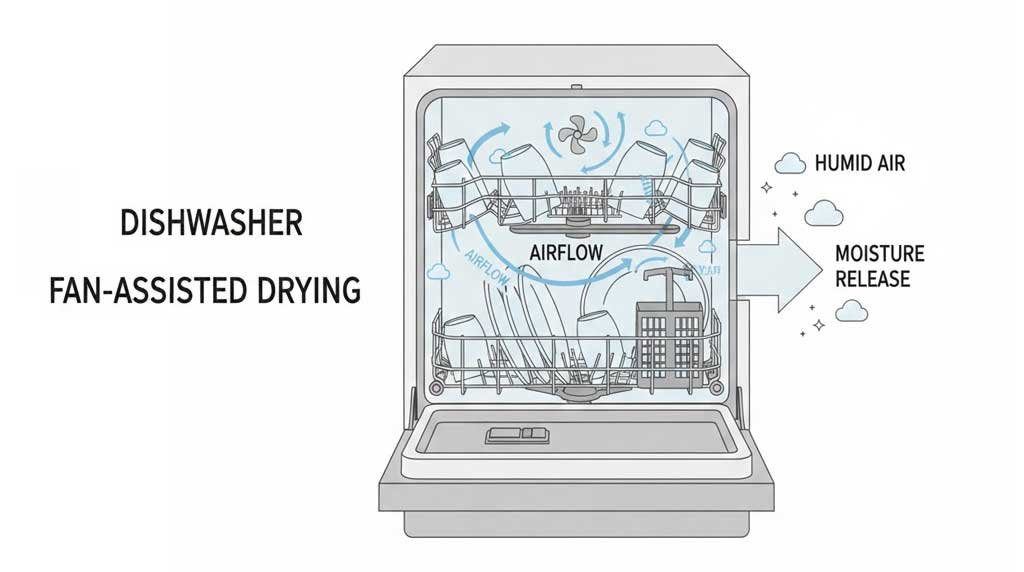
Fan-assisted drying е отговорът на индустрията на нуждата от по-добро сушене без агресивно нагряване. Вместо да разчита основно на висока температура, този метод използва контролиран въздушен поток, за да изведе влагата от ваната след последното изплакване.
How fan-assisted drying works
След края на wash фазата, вентилатор започва да циркулира въздух вътре в съдомиялната. В някои модели вратата се отваря леко автоматично, което позволява на топлия, влажен въздух да излезе и да бъде заменен със сух въздух от помещението.
In practice, this creates a slow but steady drying process. Moisture is carried away instead of being forced to evaporate by heat alone. As a result, сушенето става по-равномерно, особено при смесени товари.
Auto door opening vs internal fan
Fan drying идва в две основни форми:
- Internal fan systems, които циркулират въздуха вътре в машината
- Auto door opening systems, които освобождават влагата чрез леко отваряне на вратата
И двата подхода имат една и съща цел: да намалят влагата без допълнителен нагревател. Auto door systems често изсушават по-добре пластмаси, защото влагата има директен изход, докато вътрешните вентилатори осигуряват по-контролирана и тиха работа.
Pros of fan-assisted drying
Fan drying предлага няколко важни предимства:
- по-добра енергийна ефективност
- значително по-добро сушене на пластмаси спрямо heated dry
- по-нисък риск от деформация на съдове
Because it relies less on heat, fan-assisted drying aligns well with modern efficiency standards and eco-focused cycles.
Cons of fan-assisted drying
Недостатъкът е времето. Fan drying обикновено отнема повече време от heated dry. Освен това, резултатите могат да зависят от температурата и влажността в помещението.
In other words, fan-assisted systems trade speed for efficiency and consistency.
Who fan-assisted drying is best for
Fan-assisted drying works best for:
- energy-conscious households
- homes with a lot of plastic containers
- users who run dishwashers overnight
For many modern kitchens, this method strikes the best balance between performance and efficiency—without pushing energy use higher.
Zeolite Drying Explained (Advanced Moisture Absorption)
Zeolite drying represents a different approach altogether. Instead of heating the air or relying on ventilation alone, this method uses a natural mineral to actively absorb moisture during the drying phase.
What zeolite is and how it works
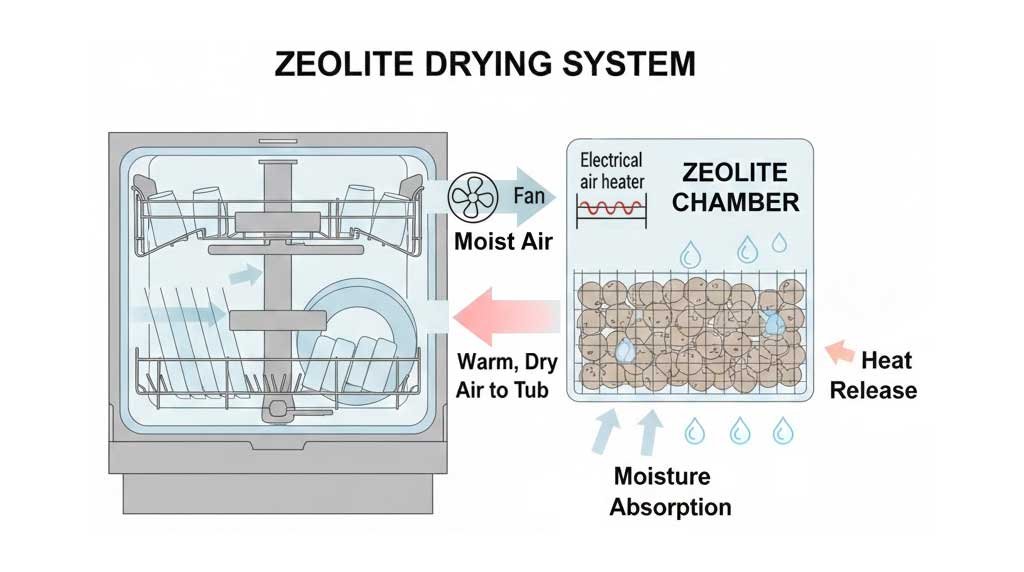
Zeolite is a porous mineral that naturally absorbs water and releases heat in the process. In dishwashers that use this technology, zeolite pellets are stored in a sealed chamber. As moist air passes through, the zeolite absorbs the humidity and releases gentle heat back into the tub.
As a result, dishes dry faster without relying on an exposed heating element.
This process is continuous and self-regulating, which means it adapts well to different load types and moisture levels.
Why zeolite dries plastics better
Plastics are where zeolite truly stands out.
If you’re shopping specifically for this technology, Bosch is the most well-known brand using zeolite-based drying in the U.S. This Bosch 800 Series buying guide breaks down models, features, and who CrystalDry is best for.
Because zeolite drying doesn’t depend solely on retained heat in the dishes, it continues pulling moisture even as plastics cool down. This is why containers, lids, and lightweight items often come out fully dry—a result that heated and fan-assisted systems struggle to match consistently.
In practice, zeolite drying delivers the most complete drying results currently available in residential dishwashers.
Energy efficiency benefits
Despite its strong drying performance, zeolite drying is also highly energy-efficient. Since the heat is generated naturally through moisture absorption, electricity use remains low.
Over time, this combination of performance and efficiency makes zeolite-based systems particularly attractive for households that value both results and utility savings.
Downsides of zeolite drying
The primary downside is cost. Dishwashers with zeolite drying systems are typically positioned in the premium price range. Additionally, this technology is currently limited to a small number of manufacturers.
That said, the zeolite material itself does not wear out under normal use, which means long-term maintenance is minimal.
Who zeolite drying is best for
Zeolite drying is ideal for:
- households with heavy plastic use
- users frustrated by consistently wet dishes
- buyers looking for the best possible drying performance
- energy-conscious homes willing to invest upfront
For many users, it represents the closest thing to “set it and forget it” drying.
Heated vs Fan vs Zeolite — Side-by-Side Comparison
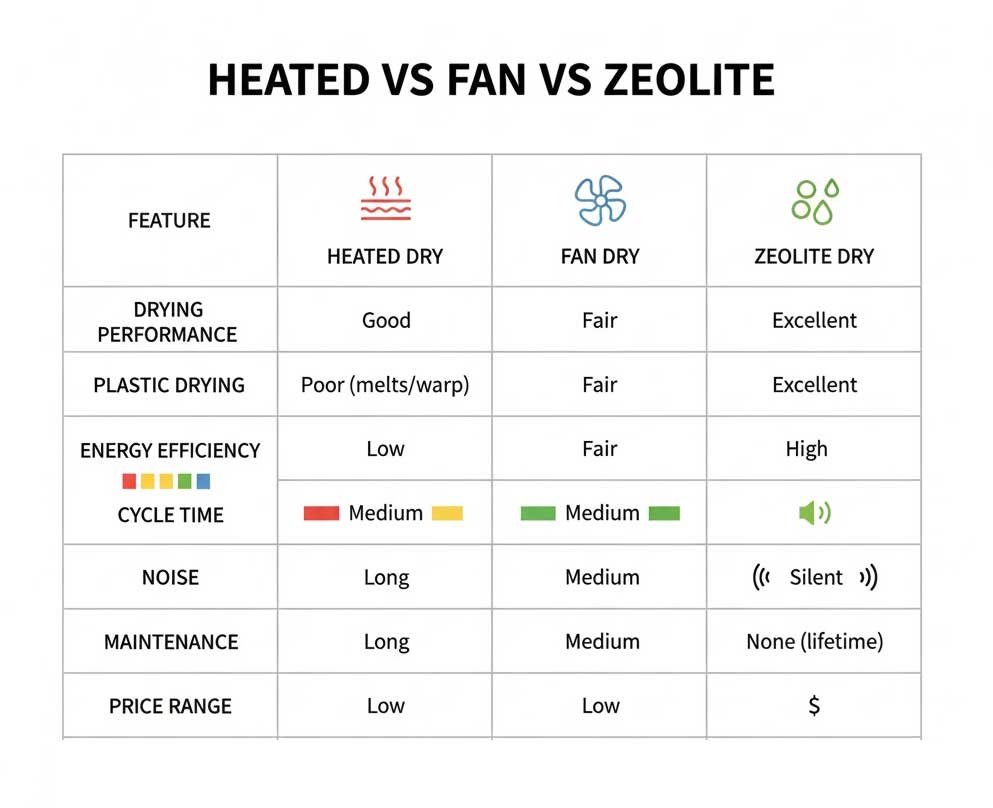
When you put all three drying methods next to each other, the differences become much clearer. Each system solves the drying problem in a different way—and those differences matter in daily use.
| Feature | Heated Dry | Fan-Assisted Dry | Zeolite Dry |
|---|---|---|---|
| Drying performance | Good (non-plastics) | Very good | Excellent |
| Plastic drying | Poor | Good | Excellent |
| Energy efficiency | Low | Medium–High | High |
| Cycle time | Short | Medium–Long | Medium |
| Noise level | Low | Medium | Low |
| Maintenance | Low | Medium | Low |
| Typical price range | Budget–Mid | Mid | Premium |
This comparison highlights an important point: there is no single “best” drying method for everyone. The right choice depends on what you value most—speed, efficiency, or consistently dry plastics.
Which Dishwasher Drying Method Is Best for You?
Choosing the right drying method becomes much easier once you align it with how your household actually uses the dishwasher.
Best for families with lots of plastics
If plastic containers, lids, and reusable items make up a large part of your loads, zeolite drying delivers the most reliable results. Fan-assisted systems are a solid second choice, while heated dry often struggles here.
Best for energy-conscious households
If lowering utility bills is a priority, our best energy-efficient dishwashers list highlights models that balance drying performance with low water and electricity use.
For homes focused on reducing energy use, fan-assisted drying and zeolite drying both perform well. Heated dry tends to consume noticeably more electricity, especially when used frequently.
Best for quiet, open-plan kitchens
Noise matters in open layouts. Zeolite systems are typically very quiet, followed closely by internal fan systems. Auto door–opening designs can be effective but may be noticeable in silent environments.
Best for budget-focused buyers
Heated dry remains the most affordable option. While it’s less efficient, it still works well for dishes made of glass and ceramic—and for users who don’t rely heavily on plastics.
Why Your Dishwasher Doesn’t Dry Well (Even With the Right Method)
Even the best drying technology can underperform if certain basics are ignored. In many cases, poor drying results are caused by usage issues, not the drying system itself.
Loading mistakes that trap moisture
Overcrowding, nesting bowls, or placing items flat prevents water from draining properly. Moisture gets trapped, and no drying method can compensate fully.
The role of rinse aid
Rinse aid reduces water surface tension, allowing droplets to slide off dishes instead of clinging. Without it, drying performance—especially on plastics—drops significantly.
If you’re not sure which product type works best or how to use it correctly, this guide to the right rinse aid for my dishwasher explains what to buy and how to avoid spotting and pooling.
Cycle selection matters
Eco and quick cycles often limit drying time. While they save energy, they may not deliver the driest results unless paired with an advanced drying method.
In practice, drying performance improves dramatically when the right method is combined with proper loading, rinse aid, and cycle choice.
FAQ — Dishwasher Drying Methods
Which dishwasher drying method works best?
Zeolite drying provides the most consistent and complete drying results, especially for plastics.
Why don’t dishwashers dry plastic well?
Plastic doesn’t retain heat, which limits evaporation. Advanced methods like fan-assisted or zeolite drying handle this better.
Does heated dry use more electricity?
Yes. Heated dry relies on an electric heating element, which increases energy consumption compared to other methods.
Is zeolite drying worth the extra cost?
For households frustrated by wet plastics and poor drying results, the improved performance and efficiency often justify the higher price.
Final Verdict — Which Dishwasher Drying Method Wins?
If the goal is simply “dry dishes,” all three methods can work under the right conditions. But when you look at real-world performance, energy use, and plastics—the differences are hard to ignore.
- Heated dry is fast and familiar but uses more energy and struggles with plastics.
- Fan-assisted drying balances efficiency and performance and works well for most households.
- Zeolite drying delivers the best overall results, especially for plastics, while remaining highly energy-efficient.
For buyers who want the best drying performance available today, zeolite drying clearly leads. For those focused on efficiency and value, fan-assisted systems offer the strongest balance.
Ultimately, the best dishwasher drying method is the one that matches your habits—not just your budget.