



Updated January 2026
This guide has been carefully reviewed and updated in January 2026 to reflect the latest U.S. safety standards, product availability, and parent-tested recommendations—so you can choose your baby’s crib with confidence.
Choosing the best baby cribs for newborns is one of those moments in early parenthood that feels both exciting and a little overwhelming. You’re not just buying furniture — you’re creating the very first safe space where your baby will rest, grow, and begin their daily rhythms.
Choosing the right crib is often the very first step when you begin putting together your list of essential baby gear for new parents. It’s a meaningful decision — one that helps shape your baby’s earliest sense of comfort and safety.
Feeling unsure at this stage is completely normal. Most parents do. Between safety standards, mattress heights, materials, and endless options, the process can easily feel bigger than it needs to be. The reassuring part is that cribs available in 2026 are safer, better tested, and more thoughtfully designed than ever before — making it easier to choose with confidence and peace of mind.
In this guide, we focus on what truly matters: safety, comfort, non-toxic materials, and real-life usability. Every crib featured here meets current U.S. safety standards and is chosen with newborn needs in mind — from those first sleepy weeks to the months ahead.
Think of this guide as a calm conversation, not a sales pitch. We’ll walk through the best options step by step, so you can choose a crib with confidence and focus on what matters most — caring for your baby and enjoying those early moments together.
Quick Picks — (2026)
If you’re short on time or simply want a clear starting point, this section highlights the best baby cribs for newborns in 2026, based on safety, build quality, materials, and parent feedback.
Each pick fits a slightly different need — because no two families, homes, or routines are exactly the same.
Best Overall Baby Crib
Babyletto Hudson 3-in-1 Convertible Crib
A consistently trusted favorite among U.S. parents, the Babyletto Hudson balances safety, style, and long-term value. Its clean design fits beautifully into most nurseries, while the sturdy construction feels reassuring from day one.
Why parents love it:
- strong, stable build that doesn’t wobble
- adjustable mattress heights for newborn to toddler stages
- GREENGUARD Gold certified for low chemical emissions
Best for:
Parents who want a reliable, well-rounded crib that grows with their baby without overthinking the decision.→ Check Price on Amazon
Best Budget Baby Crib
Graco Benton 4-in-1 Convertible Crib
Safe, simple, and budget-friendly, the Graco Benton proves that you don’t need to spend a fortune to get a crib you can trust. It meets all current safety standards and offers conversion options for later years.
Why parents love it:
- excellent value for the price
- solid construction with straightforward assembly
- converts beyond the newborn stage
Best for:
Families looking for a safe, dependable crib that keeps costs reasonable without cutting corners.→ Check Price on Amazon
Best Convertible Crib (Long-Term Use)
DaVinci Kalani 4-in-1 Convertible Crib
If you like the idea of buying once and using it for years, the DaVinci Kalani stands out. It transitions from crib to toddler bed, daybed, and eventually a full-size bed.
Why parents love it:
- classic, timeless design
- strong materials and durable finish
- excellent long-term value
Best for:
Parents planning ahead who want a crib that truly grows with their child.→ Check Price on Amazon
Best Mini Crib for Small Spaces
Babyletto Origami Mini Crib
Not every home has space for a full-size crib — and that’s perfectly okay. The Babyletto Origami Mini offers safety and comfort in a compact, foldable design that works beautifully for apartments or room-sharing setups.
Why parents love it:
- compact footprint
- easy to move and store
- ideal for newborn stages
Best for:
Small nurseries, apartments, or parents who want a space-saving newborn crib.→ Check Price on Amazon
Best Non-Toxic / Eco-Friendly Crib
Newton Galileo 3-in-1 Convertible Crib
For parents who prioritize materials and air quality, the Newton Galileo is a thoughtful, modern choice. Designed with non-toxic finishes and sustainability in mind, it pairs especially well with breathable crib mattress systems.
Why parents love it:
- non-toxic, low-VOC materials
- modern, clean design
- strong focus on newborn safety
Best for:
Families seeking a non-toxic, eco-conscious crib without compromising safety or style.→ Check Price on Amazon
Best Mainstream Value Pick
Delta Children Emery 4-in-1 Convertible Crib
Widely available and consistently reliable, this crib offers a strong balance between price, safety, and availability across major U.S. retailers.
Why parents love it:
- easy to find replacement parts and accessories
- solid safety record
- practical design for everyday use
Best for:
Parents who want a straightforward, widely trusted crib that checks all the essentials. → Check Price on Amazon
Gentle Reminder
There’s no single “perfect” crib — only the one that fits your home, your values, and your baby. Every option above is a safe place to begin your newborn’s journey.
Baby Crib Comparison — At-a-Glance Overview (2026)
If you’d like a calm, simple way to compare the best baby cribs for newborns before diving into the detailed reviews, this table offers a clear snapshot of the most important differences. Think of it as a gentle overview — designed to help you narrow your choices without feeling overwhelmed.
Comparison Table — Best Baby Cribs for Newborns
| Crib Model | Crib Type | Mattress Heights | Certifications | Best For | Availability |
|---|---|---|---|---|---|
| Babyletto Hudson | 3-in-1 Convertible | 4 | GREENGUARD Gold | Modern, all-around use | View on Amazon |
| Graco Benton | 4-in-1 Convertible | 3 | JPMA Certified | Budget-conscious families | View on Amazon |
| DaVinci Kalani | 4-in-1 Convertible | 4 | GREENGUARD Gold | Long-term use | View on Amazon |
| Babyletto Origami Mini | Mini Crib | 2 | GREENGUARD Gold | Small spaces | View on Amazon |
| Newton Galileo | 3-in-1 Convertible | 4 | GREENGUARD Gold | Non-toxic nurseries | View on Amazon |
| Delta Children Emery | 4-in-1 Convertible | 3 | JPMA Certified | Easy availability | View on Amazon |
How We Chose the Best Baby Cribs for Newborns (Our 2026 Methodology)
Choosing a crib is about more than looks or popularity. For this 2026 guide, we followed a careful, parent-first process designed to reflect real newborn needs, current U.S. safety standards, and how cribs actually perform in everyday family life.
Our goal was simple: help you feel confident that every crib on this list is a safe, thoughtful place for your baby to sleep.
Here’s exactly how we evaluated each option.
Safety Standards Come First — Always
Every crib featured in this guide meets or exceeds current U.S. safety regulations set by the Consumer Product Safety Commission (CPSC). That includes requirements for:
- slat spacing and structural integrity
- non-toxic finishes and lead-free paint
- stability and weight-bearing limits
- compliance with federal crib safety rules
We also aligned our recommendations with guidance from the American Academy of Pediatrics (AAP), especially around safe sleep environments for newborns.
If a crib didn’t meet these baseline safety expectations, it didn’t make the list — no exceptions.
Mattress Fit & Height Adjustability
A crib is only as safe as the mattress inside it. We looked closely at:
- precise mattress fit (no gaps at the edges)
- firmness and support compatibility
- multiple mattress height settings for newborns
Newborns need a higher mattress position for safe lifting and lowering, while older babies require lower settings as they grow more mobile. Cribs that made it into our top picks offer smooth, secure height adjustments that support both safety and parent comfort.
Materials, Finishes & Indoor Air Quality
Many parents today care deeply about what surrounds their baby — especially during long hours of sleep. That’s why we prioritized cribs with:
- low-VOC or non-toxic finishes
- GREENGUARD Gold or equivalent certifications
- solid wood or well-engineered materials
- smooth surfaces with no rough edges
We paid special attention to options suitable for families who are sensitive to smells, chemicals, or indoor air quality concerns.
Ease of Assembly & Everyday Use
A crib may look beautiful online — but if it’s frustrating to assemble or awkward to use, that stress shows up quickly during the newborn stage.
We considered:
- clarity of instructions
- time required for assembly
- sturdiness once assembled
- ease of adjusting mattress height
Cribs that felt unnecessarily complicated or unstable during setup were not included.
Long-Term Value & Practical Design
While newborn safety is the priority, many families also appreciate furniture that adapts over time. We evaluated:
- convertible options (crib → toddler bed → daybed)
- availability of conversion kits
- overall durability and finish longevity
That said, we didn’t overvalue “extra” conversions if they compromised sturdiness or simplicity during the newborn phase.
U.S. Availability & Parent Feedback
Finally, we focused on cribs that are:
- widely available through trusted U.S. retailers
- easy to replace parts or accessories for
- consistently well-reviewed by real parents
We looked for patterns in long-term feedback — not just first impressions — especially around stability, wear over time, and daily usability.
A Gentle Note
No crib can guarantee perfect sleep — and that’s okay. What matters is choosing a safe, supportive starting point that lets you focus on caring for your baby, not worrying about the furniture around them.
Best Baby Cribs for Newborns — In-Depth Reviews (2026)
In this section, we take a closer look at each crib that earned a place in our 2026 list. These reviews go beyond specs and marketing claims. Instead, they focus on how each crib feels to use in real life, especially during those early newborn months when simplicity and safety matter most.
Babyletto Hudson 3-in-1 Convertible Crib
Best Overall Baby Crib for Newborns
The Babyletto Hudson continues to be one of the most trusted choices for U.S. families — and for good reason. It strikes a thoughtful balance between modern design, solid construction, and long-term usability, without feeling overcomplicated.
What We Like
- strong, stable frame with no wobble once assembled
- multiple mattress height settings, ideal for newborn lifting
- GREENGUARD Gold certification for low chemical emissions
- clean, timeless design that fits most nursery styles
What Could Be Better
- conversion kit for later stages is usually sold separately
- slightly higher price than basic models
Best For
Parents who want a safe, well-rounded crib they can trust from the newborn stage onward.
Graco Benton 4-in-1 Convertible Crib
Best Budget Crib That Still Feels Solid
If you’re looking for safety and practicality without stretching your budget, the Graco Benton is a reassuring choice. It focuses on the essentials and does them well.
What We Like
- affordable price point with no compromise on safety standards
- straightforward assembly process
- convertible design for longer-term use
- widely available across major U.S. retailers
What Could Be Better
- simpler finish compared to premium models
- fewer design options
Best For
Families who want a safe, dependable crib that keeps costs manageable during the newborn stage.
DaVinci Kalani 4-in-1 Convertible Crib
Best Classic Convertible Crib
The DaVinci Kalani has been a favorite for years, especially among parents who appreciate a traditional look and long-term value. It feels sturdy and familiar — qualities that matter when you’re setting up your baby’s first sleep space.
What We Like
- solid construction with a reassuring weight and feel
- four conversion stages for extended use
- non-toxic finish and GREENGUARD Gold certification
- classic design that ages well
What Could Be Better
- bulkier than minimalist designs
- conversion parts not always included
Best For
Parents planning ahead who want a crib that transitions smoothly through early childhood.
Babyletto Origami Mini Crib
Best Mini Crib for Small Spaces
Not every home has room for a full-size crib, especially during the newborn phase. The Babyletto Origami Mini Crib offers a compact, thoughtfully designed alternative without sacrificing safety.
What We Like
- small footprint, ideal for apartments or room-sharing
- foldable design for storage or mobility
- sturdy build despite compact size
- perfect fit for the early months
What Could Be Better
- limited long-term use compared to full-size cribs
- smaller mattress options
Best For
Parents in smaller homes who want a safe, space-saving crib for newborns.
Newton Galileo 3-in-1 Convertible Crib
Best Non-Toxic & Eco-Friendly Crib
For parents who are especially mindful about materials and indoor air quality, the Newton Galileo stands out as a modern, safety-focused option. It’s designed to pair well with breathable mattress systems and low-emission nurseries.
What We Like
- non-toxic, low-VOC materials
- clean, modern design
- strong emphasis on newborn safety and airflow compatibility
- thoughtful craftsmanship
What Could Be Better
- more premium pricing
- fewer color/style options
Best For
Families looking for a non-toxic, eco-conscious crib with a modern feel.
Delta Children Emery 4-in-1 Convertible Crib
Best Mainstream Value Pick
The Delta Children Emery is a practical choice that’s easy to find, easy to assemble, and easy to live with. It may not be flashy, but it consistently delivers on safety and reliability.
What We Like
- strong safety record and stable design
- good availability of replacement parts
- convertible for extended use
- accessible price point
What Could Be Better
- basic design aesthetic
- finish may show wear over time
Best For
Parents who want a no-nonsense crib that covers all the essentials.
Gentle Reminder
All of these cribs provide a safe starting place for your newborn. The right choice is the one that fits your space, your values, and your peace of mind.
Standard vs Mini Cribs — Which One Fits Your Home?
One of the most common questions new parents ask is whether a standard crib or a mini crib makes more sense for their space. And the honest answer is: both can be wonderful — when chosen with intention.
Let’s gently break down the differences so you can decide what feels right for your home and routine.
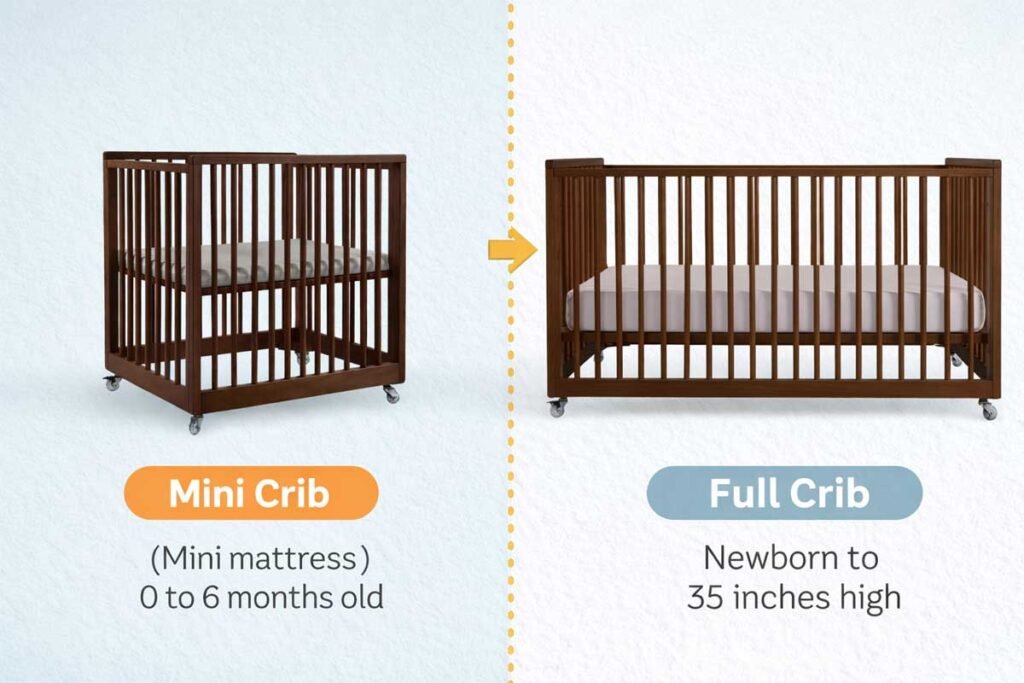
Standard Cribs: A Long-Term, All-in-One Choice
Standard cribs are the most familiar option, and for many families, they’re the right fit from day one.
They offer:
- full-size sleep space that lasts through toddlerhood
- wide mattress compatibility
- more room for baby to grow and move comfortably
If you have the space and plan to use one crib for several years, a standard crib can feel grounding — like setting down roots in your nursery from the start.
Mini Cribs: Perfect for Small Spaces & Early Months
Mini cribs are smaller, but they’re still fully safe for newborns when they meet U.S. safety standards. They can be especially helpful if you’re:
- living in an apartment
- sharing a bedroom during the newborn stage
- planning to transition later to a full-size crib
Many parents love mini cribs for their flexibility. They’re easier to fit into tight spaces and often easier to move — which can be a relief in the early weeks.
Which One Should You Choose?
If you’re unsure, ask yourself:
- How much space do we realistically have right now?
- Do we plan to room-share for the first months?
- Would flexibility reduce stress in our daily routine?
There’s no “wrong” answer here. Both options can be safe, cozy, and nurturing places for your newborn to sleep.
Convertible Cribs Explained (2-in-1, 3-in-1, 4-in-1)
Convertible cribs often sound like the perfect solution — one piece of furniture that grows with your child. And in many cases, they truly can be a great investment. Still, it helps to understand what those numbers actually mean.
What the Conversion Stages Really Mean
Here’s a simple breakdown:
- 2-in-1: Crib → toddler bed
- 3-in-1: Crib → toddler bed → daybed
- 4-in-1: Crib → toddler bed → daybed → full-size bed
Each step represents a stage of childhood, but not every family will use all of them — and that’s okay.
What’s Usually Included (and What’s Not)
One gentle surprise for many parents is that conversion kits are often sold separately. That doesn’t make the crib a bad choice — it just means planning ahead.
Before buying, it helps to check:
- whether toddler rails are included
- if full-size bed rails are available later
- total long-term cost, not just the crib price
Thinking this through early can prevent frustration down the road.
Should Conversion Features Be Your Top Priority?
For the newborn stage, safety and simplicity matter more than future conversions. If a convertible crib feels sturdy and easy to use now, the added flexibility can be a bonus — not a requirement.
It’s okay to choose what feels calm and manageable today.
Mattress Height, Ergonomics & Parent Comfort
This is a detail many parents don’t think about until they’re already lifting a sleeping baby at 2 a.m. Mattress height affects not only safety — but your comfort too.
Why Mattress Height Matters for Newborns
Newborns benefit from a higher mattress setting because it:
- makes lifting in and out easier
- reduces strain on your back and shoulders
- allows you to move slowly and safely
As your baby grows and becomes more mobile, lowering the mattress becomes essential for preventing falls.
When to Lower the Mattress
While every baby develops at their own pace, most parents lower the mattress when their baby:
- begins to push up on hands
- shows early sitting or pulling motions
- becomes more active during sleep
Cribs with smooth, clearly labeled height adjustments make this transition much less stressful.
Supporting Parents, Not Just Babies
A well-designed crib supports you too. When the mattress height works with your body, daily routines feel gentler — especially during recovery and sleep deprivation.
Small design details can make a big emotional difference.
Gentle Pause
If these choices feel like a lot, take a breath. You’re doing something deeply caring — creating a safe place for your baby to rest. One thoughtful decision at a time is more than enough.
Materials, Finishes & Non-Toxic Certifications
When your newborn spends so many quiet hours sleeping, the materials around them matter more than most parents realize. Many families today are paying closer attention to finishes, paints, and indoor air quality — and for good reason.
The good news is that in 2026, there are more crib options than ever that balance safety, durability, and peace of mind.
Solid Wood vs Engineered Wood — What’s the Difference?
You’ll often see cribs described as “solid wood” or “engineered wood,” and both can be safe when properly manufactured.
- Solid wood cribs tend to feel heavier and more traditional. They’re often very durable and long-lasting.
- Engineered wood cribs (like MDF or composite panels) can still be perfectly safe, especially when sealed properly and certified for low emissions.
What matters most isn’t the label — it’s how the materials are finished and tested.
Understanding Non-Toxic & Low-VOC Finishes
Paints and finishes can release chemicals into the air over time, especially in enclosed nursery spaces. That’s why many parents look for cribs with:
- water-based or low-VOC finishes
- lead- and phthalate-free paints
- smooth, sealed surfaces that don’t chip easily
If you’re sensitive to smells or want extra reassurance, these details can make your nursery feel calmer and cleaner from the very first night.
What GREENGUARD Gold Really Means
You’ll see the GREENGUARD Gold label mentioned often — and it’s worth understanding.
This certification means the product has been tested for low chemical emissions and is considered suitable for environments like homes, schools, and childcare settings. For many parents, it offers an added layer of confidence, especially during the newborn stage.
Cribs with this certification are often a good match for families who prioritize indoor air quality.
A Gentle Perspective
Choosing non-toxic materials doesn’t have to be all-or-nothing. Even small steps — like selecting a crib with certified finishes — can help you feel more at ease about the space your baby sleeps in every night.
Safe Sleep Basics for Newborns (AAP Checklist)
No matter how beautiful or well-made a crib is, safe sleep practices are what truly protect your baby. These guidelines come from years of research and are supported by pediatric experts across the U.S.
We’ll keep this simple and reassuring — because safety doesn’t need to feel overwhelming.
Back to Sleep, Every Time
The safest sleep position for newborns is always on their back — for naps and nighttime sleep alike. This recommendation comes directly from the American Academy of Pediatrics (AAP) and has been shown to significantly reduce sleep-related risks.
A Bare Crib Is a Safe Crib
It can feel counterintuitive, especially when nursery photos show pillows and plush accessories. But for newborns, the safest crib includes only:
- a firm, flat mattress
- a well-fitted crib sheet
No blankets, bumpers, pillows, or stuffed toys — even if they’re marketed as “breathable” or decorative.
Room-Sharing vs Bed-Sharing
The AAP recommends room-sharing (keeping the crib in your bedroom) for the early months, while avoiding bed-sharing. This setup allows you to stay close to your baby while maintaining a safe, separate sleep surface.
Many parents find that room-sharing supports both bonding and peace of mind during the newborn phase.
Crib Safety Standards Matter
All cribs sold in the U.S. must meet federal safety standards set by the Consumer Product Safety Commission (CPSC). This includes rules around slat spacing, structural strength, and banned features like drop sides.
Buying a new, regulation-compliant crib helps ensure those standards are met.
If you’re feeling unsure about how to create a truly safe sleep environment for your newborn, you’re not alone — most parents have these questions in the early weeks.
To make things easier, we’ve created a simple visual guide that highlights the most important safe sleep tips for newborns, based on current AAP and US safety guidelines. This infographic walks you through the essentials at a glance, so you can feel confident every time you put your baby down to sleep.
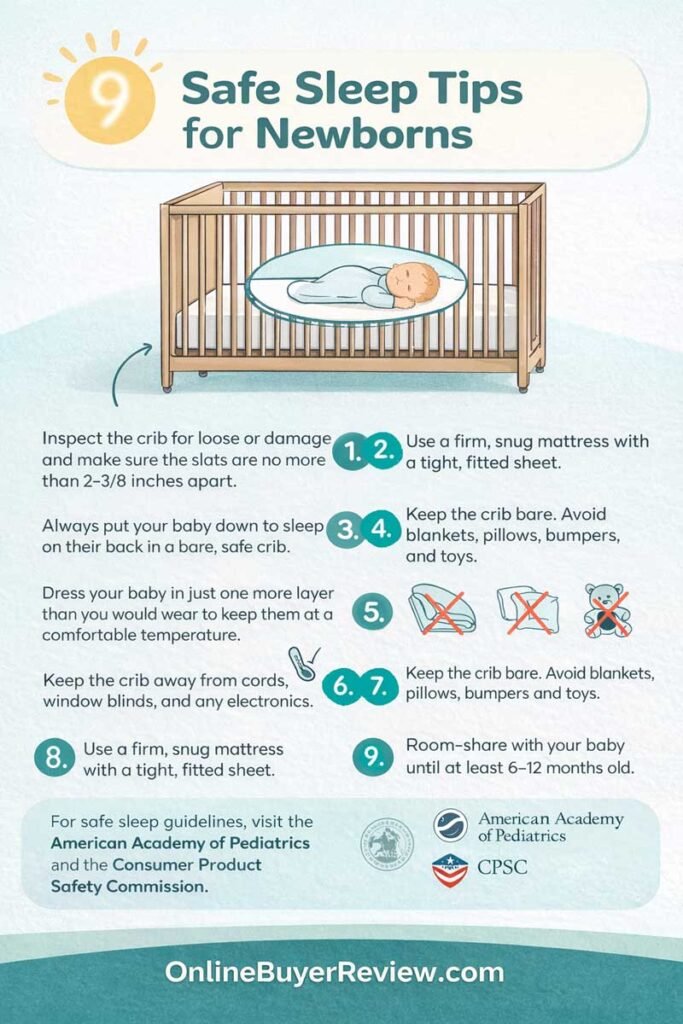
These nine safe sleep tips focus on what truly matters most: a firm crib mattress, an empty sleep space, and placing your baby on their back for every sleep. Following these basics helps reduce risks and supports healthier sleep habits from day one.
If you’d like to go deeper, we also recommend reviewing our complete Newborn Safe Sleep Guide (AAP-Based) and choosing a crib that meets current US safety standards. Small, thoughtful choices like these can make your baby’s sleep routine feel calmer and more reassuring — for both of you.
A Calm Reminder
Safe sleep isn’t about perfection — it’s about consistency. Each night you place your baby down safely, you’re doing something deeply loving and protective.
FAQs — Baby Cribs for Newborns (2026)
These are the questions parents most often ask when choosing a crib for their newborn. Clear answers—and trusted sources—can make this decision feel much calmer.
Q: Are mini cribs safe for newborns?
A: Yes. Mini cribs are safe for newborns as long as they meet current U.S. safety standards and are used with a properly fitting, firm mattress made specifically for that crib.
What matters most is not the crib’s size, but:
- a tight mattress fit (no gaps)
- a firm, flat sleep surface
- full compliance with federal crib safety rules
Authoritative source:
🔗 U.S. Consumer Product Safety Commission — Crib Safety Standards (16 CFR 1219 & 1220)
Q: What is the standard crib size in the U.S.?
A: In the U.S., a full-size crib must have interior dimensions of approximately:
- 28 inches wide
- 52⅜ inches long
This is defined by federal regulation to ensure mattress compatibility and safety.
Mini cribs do not have one universal size, which is why it’s essential to buy a mattress designed specifically for your crib model.
Authoritative source:
🔗 U.S. Consumer Product Safety Commission — Federal Crib Size Requirements
Q: Do baby cribs come with a mattress?
A: Most baby cribs do not include a mattress—and that’s intentional. It allows parents to choose a mattress based on firmness, materials, and personal preferences.
When selecting a mattress:
- it must be designed for your exact crib size
- it should fit snugly with no gaps
- it should be firm and flat
This flexibility helps support safer sleep from day one.
Q: What mattress firmness is safest for newborns?
A: Newborns should always sleep on a firm, flat mattress. Firmness helps maintain open airways and reduces the risk of unsafe sleep positions.
A simple test many parents use:
If you press the mattress with your hand, it should quickly spring back and not conform to the shape of your hand.
Authoritative source:
🔗 American Academy of Pediatrics — Safe Sleep Recommendations
Q: Are crib bumpers or “breathable” liners safe in 2026?
A: No. Crib bumpers—padded or mesh—are not safe and are restricted under U.S. law.
The Safe Sleep for Babies Act, in effect nationwide, prohibits the manufacture and sale of padded crib bumpers. The safest crib setup remains:
- a firm mattress
- a fitted sheet
- nothing else in the crib
Authoritative source:
🔗 U.S. Consumer Product Safety Commission — Safe Sleep for Babies Act
Q: How many mattress height positions do I need—and when do I lower it?
A: Three or four mattress height positions are ideal. They make the newborn phase easier while allowing safe adjustments as your baby grows.
General guidance:
- use the highest setting for newborns
- lower the mattress before your baby can sit independently
- move to the lowest setting before pulling to stand
Authoritative source:
🔗 HealthyChildren.org (AAP)
Q: When should I move my baby from a crib to a toddler bed?
A: Most children transition between 18 months and 3 years, but height and mobility matter more than age.
It’s time to transition when:
- your child is about 35 inches tall, or
- the crib rail reaches mid-chest level, or
- climbing attempts begin
Many toddlers are safest staying in a crib as long as possible, provided they haven’t outgrown it.
Authoritative sources:
🔗 Cleveland Clinic
Q: Which certifications actually matter when choosing a crib?
A: The most important certifications and standards in the U.S. are:
- CPSC compliance (mandatory for all cribs sold in the U.S.)
- ASTM standards (structural and safety testing)
- JPMA Certification (independent third-party testing)
- GREENGUARD Gold (low chemical emissions—helpful for nursery air quality)
Not every crib needs every label, but these certifications signal strong safety and quality practices.
Authoritative sources:
🔗 U.S. Consumer Product Safety Commission
🔗 UL Solutions (GREENGUARD)
Final reassurance
If you’re asking these questions, you’re already doing the right thing. Safe sleep is built from simple, consistent choices—and a well-chosen crib is a strong, loving place to start.
Final Thoughts about Choosing a Crib With Confidence
Choosing a crib is one of the first meaningful decisions you’ll make for your baby—and it’s okay if it feels big. You’re not just picking furniture; you’re creating a safe, steady place where your newborn will rest, grow, and begin their daily rhythm.
The most important thing to remember is this: a good crib is one that helps you feel calm and confident. When a crib meets current safety standards, fits your space, and aligns with your values—whether that’s simplicity, non-toxic materials, or long-term use—you’ve already made a strong choice.
There’s no need to chase perfection. Babies don’t need the most expensive option or the most talked-about brand. They need consistency, safety, and care—and those come from you. A thoughtfully chosen crib simply supports that care, night after night.
Trust your instincts. Take things one step at a time. You’re doing exactly what your baby needs—showing up with intention, love, and a desire to choose well. And that confidence will carry you far beyond this first decision.
Ready to Keep Building Your Nursery?
You may also find these guides helpful as you continue setting up your baby’s space:
- Best Crib Mattresses for Newborns – 2026 Buying Guide & Reviews
- Nursery Essentials Buying Guide (2026)
- Newborn Safe Sleep Guide (AAP-Based, 2026)
If questions come up later, that’s okay too. Parenting isn’t about having every answer — it’s about showing up with care.
💬 We’d Love to Hear from You
If you’ve already chosen a crib—or you’re still deciding—we’d love to hear your thoughts.
Did one of these options work especially well for your family?
Do you have a question we didn’t cover?
👉 Leave a comment below and share your experience or ask anything that’s on your mind. Your insight may help another parent feel a little more confident too.
You’re not doing this alone—and your voice matters here.