



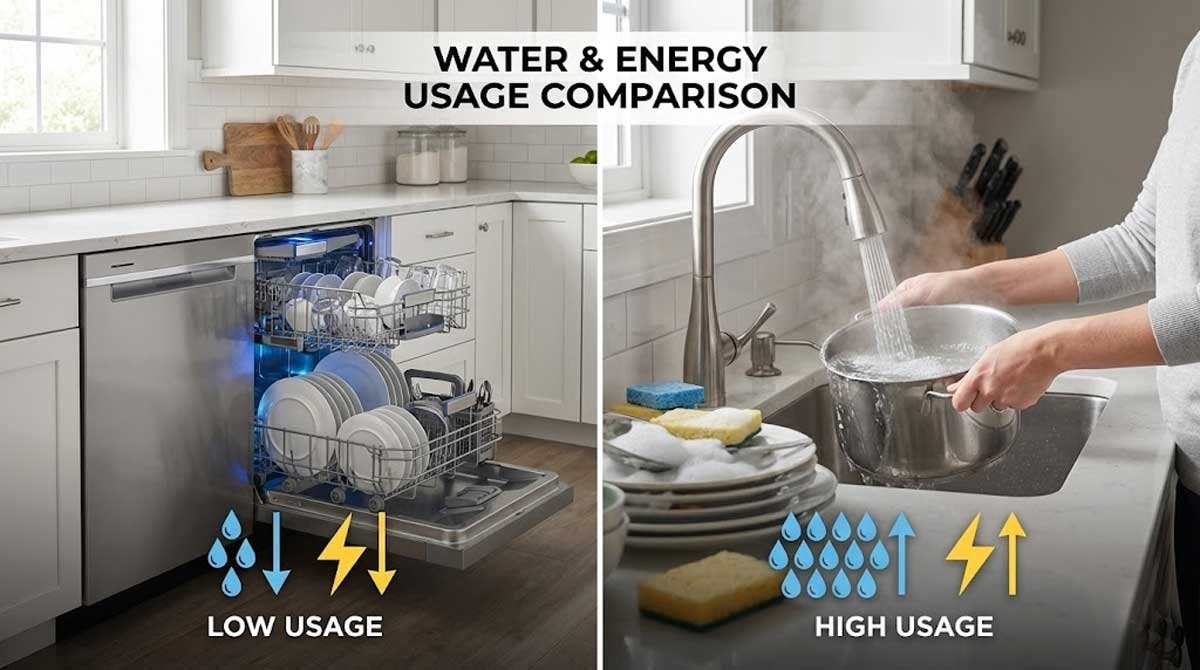
Dishwasher vs hand washing is a question almost everyone asks at some point while standing at the sink: is it really better to use the dishwasher, or are you wasting water and energy by not washing dishes by hand? For decades, hand washing has been seen as the more “responsible” option—especially for smaller loads.
To understand why these differences exist, it helps to know how a dishwasher actually works and how water circulation and heating are managed inside the machine.
However, that assumption no longer holds up the way most people think.
In practice, modern dishwashers are engineered to clean dishes using precise water volumes, controlled spray pressure, and optimized heating cycles. Hand washing, on the other hand, depends entirely on human behavior—how long the tap runs, how hot the water is, and how thoroughly dishes are rinsed.
As a result, what feels more efficient often isn’t.
This comparison breaks down the real numbers behind dishwasher use versus hand washing, focusing specifically on water consumption and energy usage in U.S. households. Once you understand where water and energy are actually being used, the difference between the two methods becomes much clearer.
How Much Water Does a Dishwasher Use?
To evaluate efficiency, we have to start with water usage—because this is where most common assumptions begin to fall apart. Many people still rely on outdated ideas about dishwashers, without realizing how much the technology has changed over the past decade.
Modern efficiency standards dramatically reduced water consumption, especially compared to older models, as explained in this breakdown of how much water a dishwasher actually uses. These improvements are not theoretical—they are built into the design and operation of today’s machines.
Modern dishwashers sold in the U.S. are designed under strict efficiency standards, including federal regulations and ENERGY STAR® requirements, which prioritize lower water and energy use without sacrificing cleaning performance. Because of this, modern dishwashers use far less water per cycle than many people expect, often cleaning a full load with less water than hand washing dishes under a running tap.
For reference, the U.S. Environmental Protection Agency outlines these standards in detail through its official ENERGY STAR dishwasher guidelines.
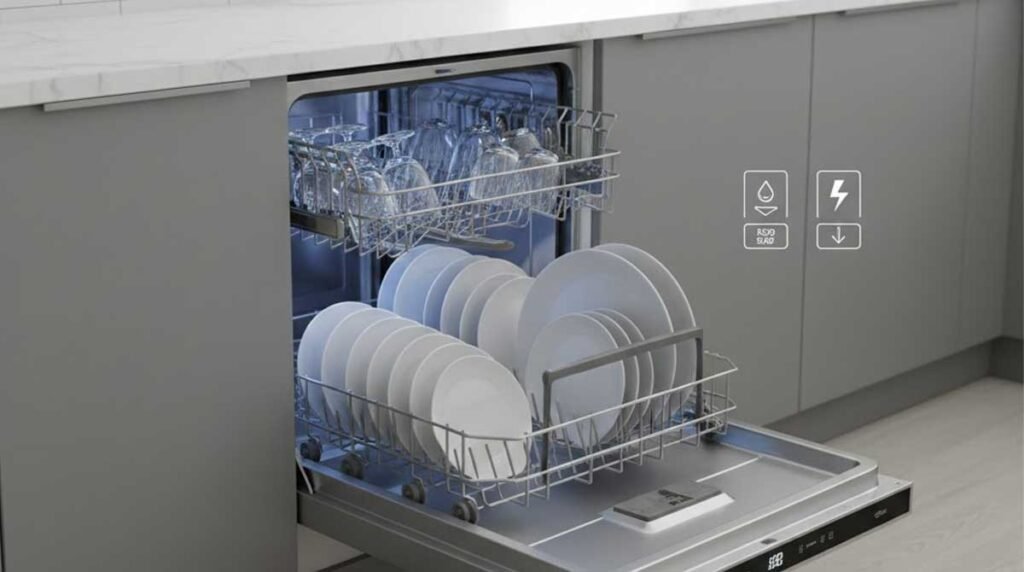
Modern dishwasher water usage per cycle
In most ENERGY STAR–certified models, a full wash cycle typically uses between 3 and 5 gallons of water. That includes washing, rinsing, and final drainage. Importantly, this water is reused and filtered multiple times during the cycle, rather than constantly flowing down the drain.
As a result, a dishwasher can clean a full load of dishes using less water than it takes to wash a few plates by hand under a running tap.
Even heavier cycles—designed for pots and baked-on food—rarely exceed 6 gallons in modern machines. Compared to older models from the early 2000s, this represents a dramatic reduction in water use.
Older dishwashers vs modern efficiency standards
Older dishwashers often deserved their reputation for being wasteful. Models built before efficiency regulations could use 10 to 15 gallons per cycle, which made hand washing appear more economical.
However, those machines are no longer representative of what’s on the market today.
Because newer dishwashers rely on soil sensors, targeted spray zones, and smarter circulation, they achieve better cleaning results while using a fraction of the water. As a result, comparing hand washing to a modern dishwasher using old assumptions leads to misleading conclusions.
How Much Water Does Hand Washing Dishes Use?
Hand washing feels controlled and efficient, but in reality, it’s highly variable—and often much less efficient than people realize.
The key difference is simple: hand washing uses continuously flowing water, while dishwashers use a fixed, measured amount.

Running tap vs filled sink — what actually happens
In the U.S., a standard kitchen faucet flows at roughly 2 gallons per minute. That means leaving the tap running for just five minutes uses around 10 gallons of water—already more than most modern dishwashers use for an entire cycle.
While some people fill the sink and wash in batches, many still rinse dishes individually under running hot water. Over the course of a typical meal cleanup, that adds up quickly.
More importantly, most people underestimate how long the tap is actually running.
Why hand washing often uses more water than expected
Hand washing also involves repeated rinsing. Dishes are washed, set aside, and then rinsed again—often with hot water. Because of this, water use increases without much awareness.
As a result, even a careful hand-washing routine can easily exceed 15 to 20 gallons of water per session, especially in households with multiple people or larger meals.
In practice, hand washing only uses less water than a dishwasher under very specific conditions—small loads, cold water, and minimal rinsing. Outside of that narrow scenario, it usually consumes significantly more.
Energy Use — Dishwasher vs Hand Washing
Once water usage is clear, the next—and often more expensive—factor is energy. Specifically, the energy required to heat water. This is where many people misjudge efficiency, because the dishwasher itself doesn’t feel energy-hungry in the same way a hot faucet does.
This efficiency gap becomes even clearer when looking at modern energy-efficient dishwasher designs and eco-focused wash cycles.
However, energy use doesn’t disappear just because you don’t see it.
Energy used to heat water
In both cases—dishwasher or hand washing—the biggest energy cost comes from heating water. The difference is how efficiently that heating is managed.
Dishwashers heat water in a controlled, insulated environment. They bring a precise amount of water to the target temperature and reuse it throughout the cycle. As a result, very little heat is lost.
Hand washing, by contrast, relies on a continuous flow of hot water. Heat is lost instantly as water runs down the drain, which forces the water heater to keep reheating fresh water. Because of this, hand washing almost always uses more energy than people expect, especially when hot water is left running for extended periods.
Electricity consumption of modern dishwashers
Modern ENERGY STAR dishwashers typically use between 1.2 and 1.5 kWh per cycle, depending on the selected program. Eco cycles use even less by extending wash time while lowering peak temperatures.
In practice, that amount of electricity costs only a few cents per load in most U.S. states. More importantly, the energy use is predictable and capped.
By comparison, hand washing has no upper limit. The longer the tap runs, the more energy is consumed—without any efficiency mechanism to stop it.
As a result, dishwashers usually come out ahead on energy efficiency, particularly in households that use hot water generously at the sink.
Cost Comparison for U.S. Households
When water and energy are combined, cost differences become easier to see. While neither method is expensive on a per-use basis, small differences add up over time.
Monthly and yearly cost estimates
In a typical U.S. household, running a modern dishwasher once per day adds up to only a few dollars per month in combined water and electricity costs. Over a year, that usually remains well under the cost of many common kitchen appliances.
Hand washing, on the other hand, varies widely. Households that leave the tap running, use very hot water, or wash multiple times per day can easily exceed dishwasher costs—sometimes by a noticeable margin.
As a result, what feels cheaper in the moment often turns out to be more expensive over the long term.
When hand washing may cost more
Hand washing becomes particularly costly when:
- hot water is used continuously
- dishes are rinsed multiple times
- cleanup happens several times per day
Because energy costs are tied directly to water heating, even modest inefficiencies compound quickly.
In contrast, dishwashers keep costs predictable. They use fixed water volumes, controlled temperatures, and optimized cycles. Over time, that consistency is what makes them the more economical option for most households.
Environmental Impact — Which Is More Sustainable?
Beyond cost and convenience, water and energy use also translate directly into environmental impact. And here again, the difference between dishwashers and hand washing is less about intention—and more about efficiency.
Because modern dishwashers use measured water volumes and controlled heating, they typically generate a smaller environmental footprint per load. Less water heated means less energy consumed, which in turn means lower emissions from power generation or gas heating.
Hand washing, however, is inconsistent by nature. When hot water runs continuously, both water waste and energy waste increase simultaneously. As a result, even well-intentioned habits can lead to higher overall environmental impact—especially in regions where water heating relies on fossil fuels.
In practical terms, a properly used dishwasher is usually the more sustainable option for most U.S. households.
When Hand Washing Can Be More Efficient
That said, hand washing is not always the worse choice. Under specific conditions, it can still be efficient.
Hand washing may use less water and energy when:
- only a few lightly soiled items need cleaning
- cold or lukewarm water is used
- the tap is turned off between washing and rinsing
In these limited scenarios, firing up a full dishwasher cycle may not make sense. The key is moderation. Small loads done quickly and intentionally can keep hand washing efficient.
However, once dish counts increase or hot water enters the equation, efficiency drops quickly.
When a Dishwasher Is Clearly the Better Choice
For everyday meals, family dinners, and regular cleanup, dishwashers have a clear advantage.
A dishwasher is the better option when:
- washing a full or nearly full load
- using an ENERGY STAR–certified model
- running eco or normal cycles
- allowing dishes to air-dry
Because dishwashers control water use, temperature, and cycle timing, they remove guesswork from the equation. As a result, efficiency stays consistent regardless of user habits.
For most households, this consistency is what makes dishwashers both cheaper and more sustainable over time.
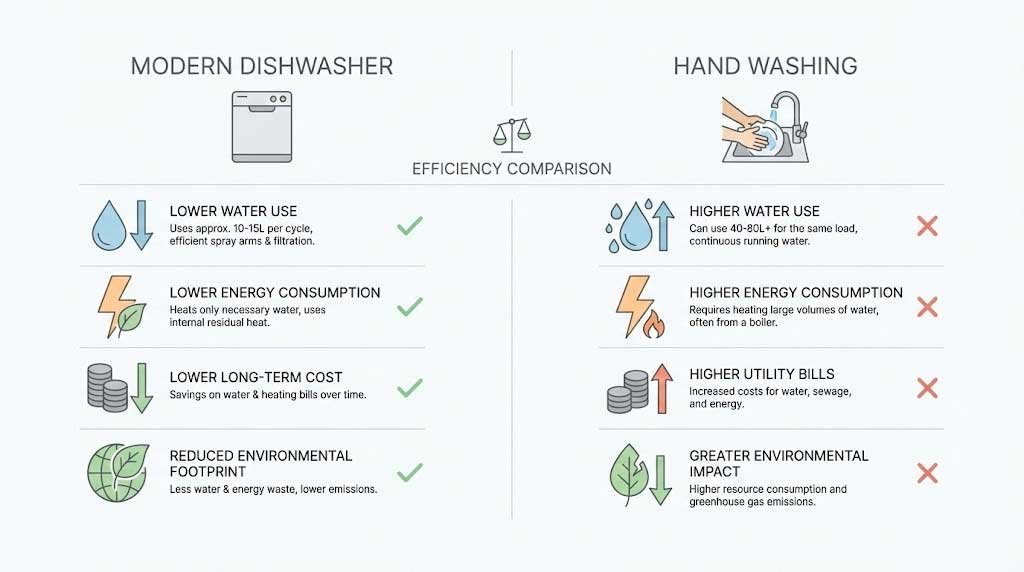
Dishwasher vs Hand Washing — Quick Comparison
| Factor | Dishwasher | Hand Washing |
|---|---|---|
| Water usage | Lower (modern models) | Higher (typical use) |
| Energy consumption | Controlled and efficient | Often higher due to hot water |
| Cost over time | Lower | Can be higher |
| Environmental impact | Lower | Higher in most cases |
| Best use case | Full loads | Very small loads |
This comparison highlights the core takeaway: efficiency depends on control, and dishwashers are built to provide it.
FAQ – Dishwasher vs Hand Washing
Q: Does a dishwasher really use less water than washing dishes by hand?
А: In most U.S. households, yes. Modern dishwashers use a fixed amount of water per cycle, while hand washing often involves running hot water continuously, which quickly exceeds dishwasher usage.
Q: Is hand washing cheaper than using a dishwasher?
А: It can be cheaper for very small loads washed quickly with minimal hot water. However, for regular daily dishwashing, dishwashers usually cost less over time due to controlled water and energy use.
Q: Do dishwashers save energy compared to hand washing?
А: Yes. Dishwashers heat a limited amount of water efficiently and reuse it, while hand washing continuously draws hot water, increasing energy consumption.
Q: Which option is better for the environment?
А: For full loads, dishwashers are generally more environmentally friendly because they use less water and energy overall. Hand washing only competes in efficiency for very small, quick jobs.
Final Verdict — Which Uses Less Water and Energy?
For most U.S. households, the answer is clear.
When used correctly, modern dishwashers use less water and less energy than hand washing, especially for full loads and regular daily use. They reduce waste, control costs, and deliver consistent results without relying on perfect habits.
Hand washing still has its place—for quick jobs and small loads—but once dishes pile up, the dishwasher becomes the more efficient, economical, and environmentally responsible choice.
In short, the question isn’t whether dishwashers can be efficient. It’s whether we use them the way they were designed to be used.
For households looking to maximize savings, choosing one of today’s best energy-efficient dishwashers makes the difference even more noticeable.