



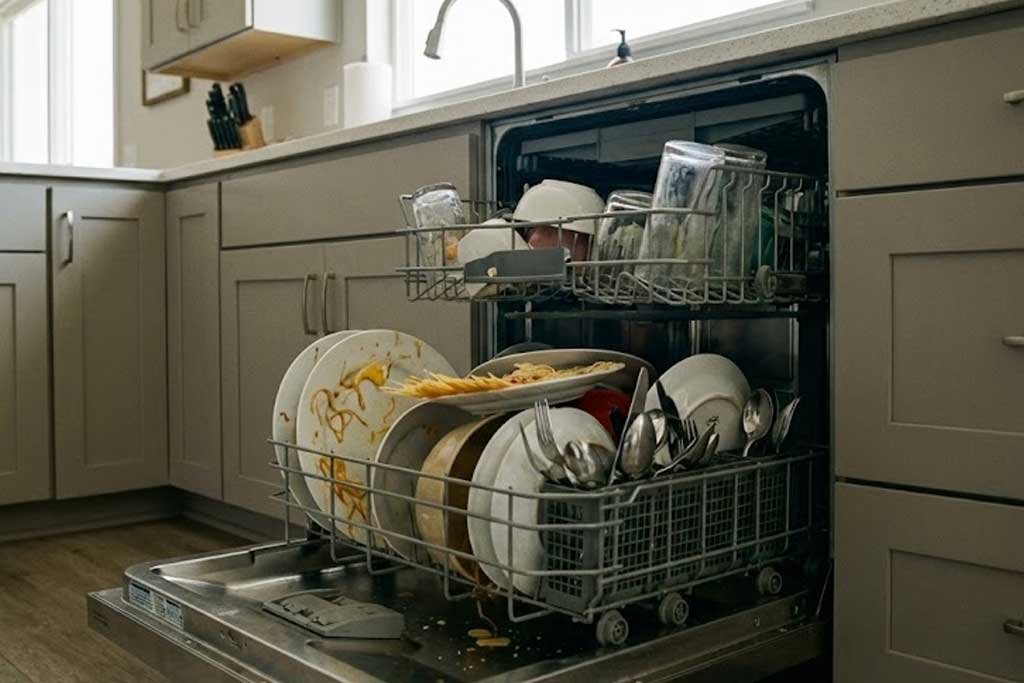
Why my dishwasher doesn’t clean well is a question many homeowners ask after running a full cycle and still pulling out greasy plates, cloudy glasses, and half-clean silverware. To understand why this happens, it helps to know how a dishwasher actually works. Once you understand how water pressure, spray arms, and circulation interact inside the machine, the impact of loading habits becomes much easier to see.
At that point, most people jump to the same conclusion—something must be wrong with the dishwasher.
In reality, that’s rarely the case.
In practice, the majority of dishwasher cleaning problems don’t come from worn-out parts, weak motors, or bad detergent. Instead, they come from how the dishwasher is loaded. Because dishwashers rely on precise water flow, spray angles, and timing, even small loading mistakes can quietly destroy cleaning performance without triggering any obvious errors.
The key reason this problem is so common is simple: modern dishwashers are far less forgiving than older models. They use less water, rely on smarter sensors, and depend heavily on proper dish placement to work correctly. As a result, habits that used to work now lead to consistently poor results.
This article explains why your dishwasher doesn’t clean well, how loading habits interfere with performance, and what’s actually happening inside the machine when dishes come out dirty.
Most Dishwasher Cleaning Problems Start With Loading
Dishwashers are not designed to “wash everything evenly.” They are engineered systems that clean based on directional water spray, controlled pressure, and unobstructed circulation. When loading works against that design, cleaning efficiency drops immediately.
If you’re wondering why my dishwasher doesn’t clean well even though it runs normally, loading habits are almost always the missing piece.
Some loading issues go beyond placement and involve items that simply don’t belong in the dishwasher at all. Certain materials and kitchen tools can block spray paths, trap residue, or interfere with circulation. If you’re unsure which items should stay out of the machine, this guide on what not to put in a dishwasher breaks it down clearly.
The critical point to understand is this: water can only clean what it can physically reach.
When dishes are placed too close together, facing the wrong direction, or stacked without spacing, they create shadow zones. In those areas, water pressure weakens, detergent concentration drops, and food residue simply doesn’t get removed. As a result, the dishwasher completes the cycle successfully—but cleaning performance fails.
What makes this especially frustrating is that nothing looks wrong. The cycle finishes. No error codes appear. Yet the outcome is consistently poor.
From a mechanical standpoint, this is exactly what happens when loading habits block spray paths and disrupt circulation. The dishwasher isn’t broken—it’s being prevented from doing its job.
How Water Spray Arms Actually Clean Your Dishes
To understand why loading matters so much, you first need to understand how dishwashers clean at a fundamental level.
Dishwashers don’t scrub. They don’t soak dishes clean. Instead, they rely on high-pressure water jets delivered through rotating spray arms. These arms follow fixed paths and spray at specific angles designed to hit dish surfaces directly.
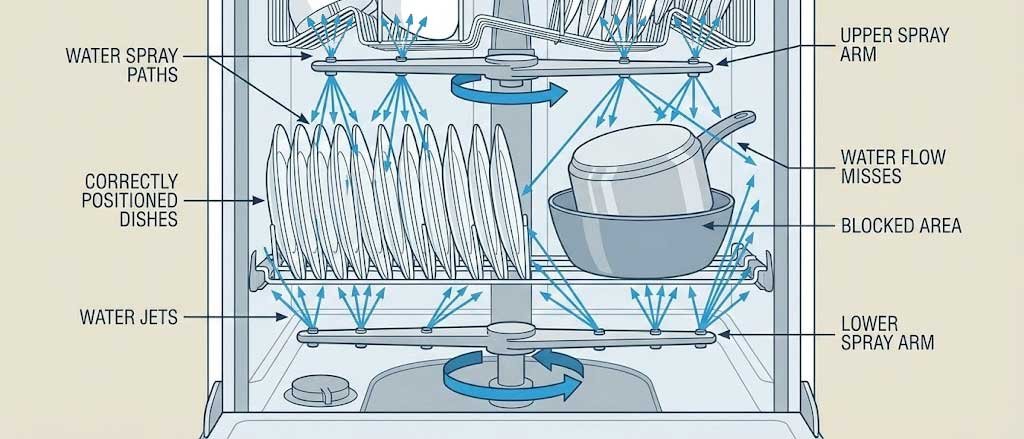
Because of that, dish orientation is everything.
When a plate, bowl, or pan blocks the spray arm—even partially—it reduces water pressure not only for that item, but for everything behind it. More importantly, when dishes face away from the spray, water simply glances off instead of breaking down grease and residue.
This is why:
- plates must face inward
- bowls must be angled
- large cookware must never sit flat
Once spray paths are interrupted, detergent cannot activate properly, rinsing becomes uneven, and food particles redeposit onto nearby items. As a result, dishes may look “mostly clean” but still feel greasy, gritty, or cloudy.
In short, loading determines whether the dishwasher’s cleaning system can function as designed. If water flow is compromised, no cycle length or detergent upgrade can fully compensate.
Why Overloading Breaks Dishwasher Performance
Overloading is one of the most common habits that quietly ruins dishwasher performance. It feels efficient—fewer loads, less time—but mechanically, it works against how the machine is designed to clean.
The moment too many items are packed into the racks, several problems happen at once.
First, water pressure is divided across too many surfaces. Instead of hitting dishes with enough force to break down grease and dried-on food, the spray weakens. As a result, detergent cannot activate properly, and food residue stays attached.
Second, overcrowding restricts spray arm movement. Even slight contact or partial obstruction changes spray patterns, which leads to uneven cleaning throughout the load. Some items may come out clean, while others—often in the same spots every time—remain dirty.
More importantly, overloading increases redepositing. When food particles aren’t fully flushed away, they circulate and settle back onto nearby dishes. This is why overloaded loads often feel gritty or greasy even after a full cycle.
In practice, a slightly smaller load with proper spacing almost always cleans better than a completely full dishwasher. Modern machines are optimized for efficiency, not volume—and they perform best when loading respects that balance.
Bottom Rack vs Top Rack — Where Cleaning Goes Wrong
Many dishwasher performance issues come down to placing the right items in the wrong rack. While both racks are part of the same system, they serve very different purposes.
The bottom rack is designed for heavy-duty cleaning. It receives the strongest spray and the highest heat. Plates, pots, pans, and heavily soiled items belong here—provided they’re positioned correctly.
Problems begin when large cookware is placed flat or directly in front of the spray arm. Flat surfaces block water flow and create shadow zones behind them. As a result, not only does the cookware clean poorly, but everything around it suffers too.
The top rack, on the other hand, is built for controlled, gentler spray. Glasses, mugs, bowls, and lightweight plastics are meant to be placed here. However, when bowls are nested, glasses are placed upright, or plastics aren’t secured, water pools instead of draining. This leads to cloudy glassware, water spots, and poor drying.
In both cases, the mistake isn’t the rack itself—it’s ignoring how water is meant to move through each level. Once items block circulation or disrupt spray direction, cleaning consistency drops sharply.
Understanding the difference between rack functions is critical. When items are placed where they belong and angled correctly, water flow improves immediately—and so does cleaning performance.
Silverware That Looks Clean but Isn’t
Silverware problems are deceptive. At first glance, forks and spoons may look clean. However, once you touch them—or worse, use them—you notice a gritty feel, a faint odor, or leftover residue along the edges.
This almost never means the dishwasher failed. It means the silverware wasn’t exposed to water properly.
The most common cause is nesting. When spoons sit inside spoons or forks stack tightly together, water and detergent can’t reach all surfaces. As a result, only the outer utensils get cleaned, while the inner ones stay partially dirty.
Another frequent issue is overcrowding the basket. When too many utensils are packed into a small space, spray pressure drops sharply. Detergent becomes diluted, and food particles circulate instead of being flushed away.
In practice, silverware cleans best when:
- utensils are mixed, not grouped
- space is left between items
- the dirtiest ends are fully exposed
Once these conditions are met, silverware issues often disappear immediately—without changing cycles or detergents.
When It’s Not the Detergent or the Machine
When dishes don’t come out clean, detergent is usually the first thing people blame. They switch brands, try stronger formulas, or add more product. However, detergent is rarely the root cause.
Modern dishwashers rely on specific dishwasher features such as soil sensors, targeted spray zones, and reduced water usage. Because of this, newer machines are far more sensitive to loading errors than older models.
Even the best detergent cannot work if water flow is blocked.
Detergents are designed to activate under specific conditions: proper spray coverage, correct water temperature, and consistent circulation. When loading interferes with any of these factors, detergent performance collapses—regardless of quality.
The same logic applies to the dishwasher itself. Many modern dishwashers are replaced prematurely, not because they’re broken, but because loading habits haven’t adapted to newer designs. Compared to older models, today’s machines use less water and rely more heavily on precise placement to clean effectively.
In other words, the machine is often doing exactly what it’s designed to do—it’s just being fed the wrong conditions.
Before assuming mechanical failure or spending money on replacements, correcting loading habits should always be the first step.
Signs Your Dishwasher Is Loaded Incorrectly
When a dishwasher is loaded incorrectly, it usually sends clear signals—if you know what to look for. These symptoms tend to repeat in the same places, cycle after cycle, because the underlying cause never changes.
The most common warning signs include:
- Food residue in the same spots every time
This almost always indicates blocked spray paths or dishes facing away from the water jets. - Cloudy or streaked glassware
Poor spacing and upright placement prevent proper rinsing and drainage. - Detergent tablets that don’t fully dissolve
Items placed in front of the dispenser can delay or block detergent release. - Silverware that smells clean but doesn’t feel clean
Nesting and overcrowding prevent full exposure to water and detergent.
Individually, these issues may seem minor. Taken together, they point directly to loading habits that interfere with circulation and spray coverage.
Quick Fixes Before You Call a Technician
Before assuming your dishwasher needs service—or worse, replacement—there are a few adjustments worth making. These fixes take less than two minutes and resolve the majority of cleaning complaints.
First, reduce the load size slightly. Giving water more room to move often improves performance immediately.
Next, re-angle plates and bowls so dirty surfaces face the spray arms. Avoid flat placement, especially for large cookware.
Then, check spray arm movement. Spin them by hand before starting a cycle. If anything makes contact, water flow will suffer.
Finally, keep the detergent dispenser unobstructed. Large plates or cutting boards placed in front of it can prevent detergent from releasing at the right time.
In practice, these simple changes restore proper cleaning far more often than people expect.
FAQ – Dishwasher Cleaning Problems
Why does my dishwasher run but still leave dishes dirty?
In most cases, the dishwasher is working correctly, but dishes are blocking water spray or detergent circulation. Incorrect loading prevents water from reaching dirty surfaces, which results in poor cleaning even after a full cycle.
Can incorrect loading really affect dishwasher performance?
Yes. Dishwashers rely on precise spray patterns and water pressure. When items are overcrowded, nested, or facing the wrong direction, cleaning performance drops significantly regardless of detergent or cycle selection.
Is overloading a common reason for poor dishwasher cleaning?
Absolutely. Overloading restricts spray arm movement, reduces water pressure, and causes food particles to redeposit onto dishes instead of being flushed away.
Should I change detergent if my dishwasher doesn’t clean well?
Before changing detergent, check your loading habits first. Even high-quality detergents cannot work effectively if water flow is blocked or dishes are placed incorrectly.
Final Thoughts — Fix the Habit Before Replacing the Dishwasher
When a dishwasher doesn’t clean well, the instinct is to blame the machine. However, in most cases, the real issue isn’t mechanical—it’s behavioral.
Dishwashers are designed to clean efficiently using precise spray patterns, controlled water pressure, and unobstructed circulation. When loading habits align with that design, performance improves quickly and consistently.
Before spending money on repairs, new detergents, or a replacement unit, fix the habit first. Cleaner dishes, better drying, and fewer rewashes usually follow.
And if you want a clear, visual breakdown of exactly how to place dishes rack by rack, follow our step-by-step dishwasher loading guide for a practical walkthrough that complements the principles explained here.