



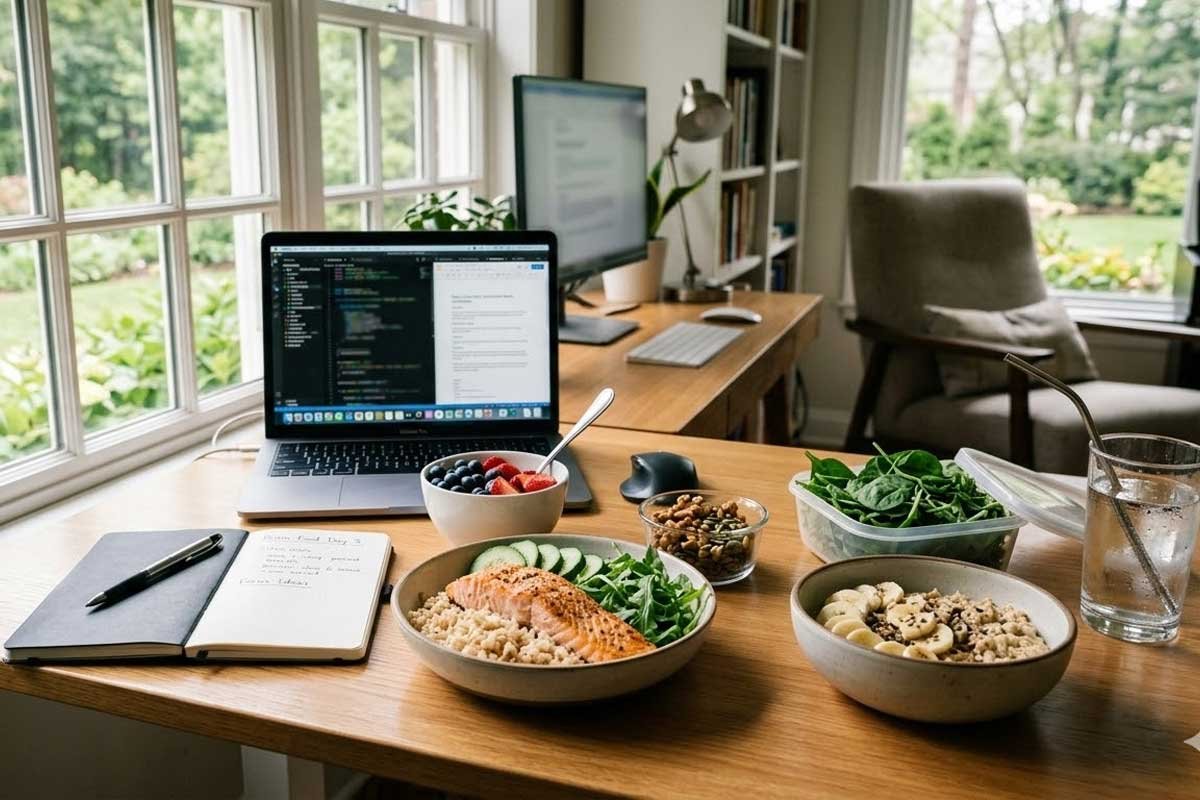
Long workdays can do something weird to your eating habits. You start with decent intentions, then somewhere between your second coffee and a late afternoon deadline, breakfast is a blur, lunch is rushed, and snacks turn into whatever is easiest to grab.
That matters more than most people think. While no single food is a magic fix for focus, a balanced eating pattern built around whole foods may help support steadier energy, better concentration, and fewer of those sluggish mid-afternoon crashes that make even simple tasks feel harder than they should. Brain-friendly eating patterns such as the Mediterranean and MIND styles of eating emphasize foods like leafy greens, berries, whole grains, nuts, and fish rather than heavily processed, high-sugar options.
If your job involves long hours at a desk, mentally demanding work, or back-to-back problem solving, your meals should be helping you, not working against you. And if you are planning your week ahead, this is also a smart place to connect readers to your brain-healthy lunch recipes article with an internal link right in the intro.
Here are five of the best foods for brain health during long workdays, starting with one of the strongest practical options you can put on your plate.
1. Fatty Fish
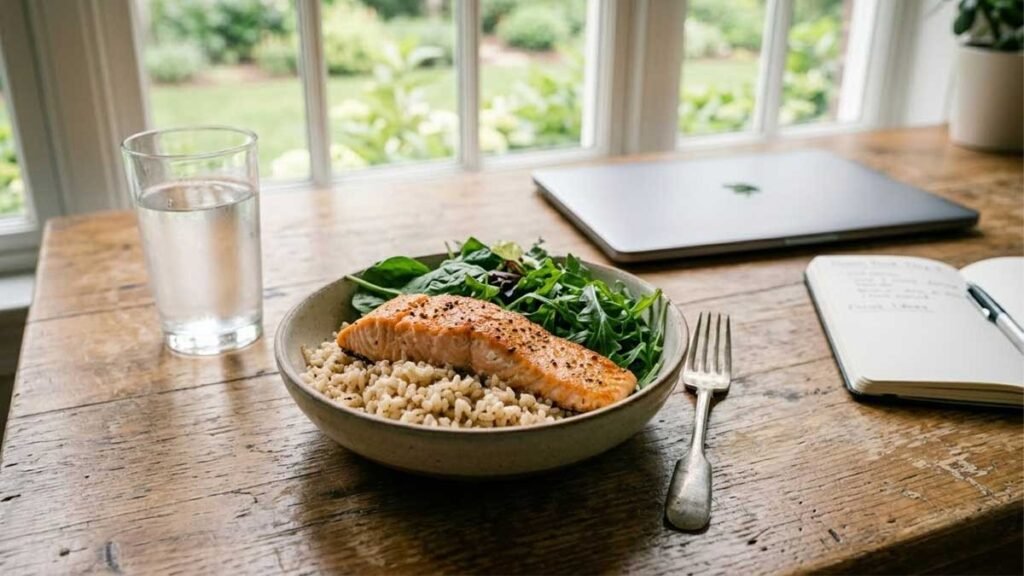
Fatty fish is one of those foods that keeps showing up in brain-health conversations for a reason. Eating patterns linked with cognitive health, including the MIND diet, commonly include fish as a regular part of the week, and NIH materials describing brain-supportive eating patterns specifically list fish alongside leafy greens, berries, nuts, and whole grains.
Just as importantly for everyday work life, fatty fish is practical. It gives you a real meal with staying power, not the kind of quick hit that feels fine for 30 minutes and then disappears the moment your inbox gets ugly. Salmon, sardines, tuna, herring, and mackerel are also recognized sources of omega-3 fats, which MedlinePlus notes may be important for heart and brain health.
Why fatty fish works well on demanding workdays
A long workday usually punishes two kinds of meals: the ultra-light snack lunch that leaves you hungry an hour later, and the oversized heavy lunch that makes you want a nap at 2:30 p.m. Fatty fish tends to sit nicely in the middle. It feels substantial, pairs easily with whole grains and vegetables, and fits the kind of whole-food eating pattern the CDC recommends more broadly.
There is also a simplicity factor here that people underestimate. Good workday nutrition does not have to be fancy. In fact, it usually works better when it is boring in the best possible way: repeatable, easy to prep, easy to pack, and easy to eat without turning lunch into a side project.
Easy ways to eat more fatty fish during the week
You do not need a perfect meal plan or chef-level skills to make this work. A few easy options are more than enough:
- salmon with brown rice and greens
- a tuna wrap on a whole-grain tortilla
- sardines on toast with sliced tomato
- a quick salmon salad bowl with cucumbers and olive oil
- canned tuna mixed with plain Greek yogurt instead of a heavier dressing
These kinds of meals work especially well because they are not just about the fish itself. They naturally pull in other helpful foods too, like whole grains and vegetables, which are also part of eating patterns associated with better overall diet quality.
The best time to eat it
For most people, lunch is the sweet spot.
That is when focus often starts to wobble, and it is also where bad food decisions can quietly wreck the second half of the day. A lunch built around salmon or tuna usually gives you a more stable foundation than a pastry, chips, or a random vending-machine combo pretending to be a meal.
Dinner works too, especially if you are prepping ahead for the next day. Leftover salmon over rice or greens makes one of the easiest office lunches you can pack, and it feels a lot more like an actual plan than grabbing something sugary at 11:47 because meetings ran long.
A practical note most readers will appreciate
If fresh fish feels expensive or unrealistic every week, do not overcomplicate it. Canned salmon, canned tuna, and sardines are affordable, easy to store, and fast to use. That matters because the best brain-friendly food is not the one that sounds impressive in theory. It is the one you will actually keep in the kitchen and eat on a Wednesday.
And that is really the theme of this whole article: better focus during long workdays usually starts with better defaults, not heroic effort.

2. Berries
Berries are one of the easiest brain-friendly foods to keep in regular rotation, especially during long workweeks when convenience starts winning every argument. They are also a natural fit here because the MIND eating pattern specifically favors berries over other fruits, alongside leafy greens, whole grains, nuts, beans, and fish as part of an overall brain-supportive diet pattern.
Why berries make sense on busy workdays
A lot of workday snacks fail for the same reason: they are easy, but they do not really help. A muffin, candy bar, or giant sweetened coffee can feel useful in the moment, then leave you dragging not long after. Berries are different. They are light, simple, easy to pair with more filling foods, and they fit naturally into the kind of healthy eating pattern that emphasizes fruits, vegetables, healthy fats, and whole grains instead of heavily processed options.
They also solve a practical problem. When people say they want to eat better during mentally demanding days, they usually do not need a dramatic nutrition reset. They need a few reliable foods they can buy every week without thinking too hard about it. Blueberries, strawberries, raspberries, and blackberries all work well here because they can slide into breakfast, snacks, or even a quick desk lunch without turning food prep into a project.
Easy ways to add berries to your routine
This is where berries really earn their spot. They are not just “healthy.” They are usable.
A few easy options:
- blueberries mixed into oatmeal
- strawberries with plain Greek yogurt
- raspberries added to a snack box with nuts
- frozen berries blended into a smoothie
- blackberries with cottage cheese or overnight oats
These combinations work well because they help you build a more balanced meal or snack instead of relying on sugar alone. The American Heart Association’s general eating guidance also leans toward this bigger-picture approach: not hunting for miracle foods, but building meals around fruits, vegetables, whole grains, nuts, beans, and other minimally processed staples.
The easiest way to keep berries from becoming “aspirational fridge food”
Buy what you will actually use.
Fresh berries are great, but frozen berries may be even more practical for many people. They last longer, cost less in many stores, and are always ready for oatmeal, yogurt bowls, or smoothies. That matters because a smart food is only smart if it survives your actual schedule. Not the ideal version of your schedule. The real one.
And honestly, that is the hidden advantage of berries during long workdays: they make healthy eating feel easier instead of more complicated.
3. Nuts and Seeds
Nuts and seeds are one of the best foods to keep around when your brain is working hard and your schedule is messy. They are portable, shelf-stable, easy to portion, and much more useful than the usual office snack lineup. They also belong in this conversation for a reason: the MIND eating pattern includes nuts as one of its core food groups, and MedlinePlus notes that nuts and seeds such as walnuts, pumpkin seeds, flaxseed, and chia can provide omega-3 fats, which may be important for heart and brain health.
Why they work so well for long desk days
Long workdays tend to create “accidental snacking.” You are not really hungry in a planned, reasonable way. You just reach for something because meetings stacked up, lunch got delayed, or your energy started falling apart around 3 p.m.
That is where nuts and seeds shine. They are easy to keep in a drawer, bag, or lunchbox, and they fit neatly into broader healthy eating guidance that emphasizes nuts, legumes, fruits, vegetables, whole grains, and lean proteins over highly processed snacks high in added sugar, sodium, or saturated fat.
There is also a “default choice” benefit here. If a pack of almonds or walnuts is the easiest thing to grab, you are already making the day easier on yourself. Better focus often starts with better defaults, not better intentions.
Best nuts and seeds to keep on hand
You do not need a massive variety. A few dependable options are enough:
- walnuts
- almonds
- pumpkin seeds
- chia seeds
- ground flaxseed
- mixed unsalted nuts
Walnuts and seeds are especially useful because MedlinePlus lists several of them as food sources of omega-3 fats, and polyunsaturated fats, including omega-3s, are described as essential fats the body needs for brain function and cell growth.
Easy ways to use them without overthinking it
This is where many people get stuck. They buy healthy foods, then wait for the perfect recipe. You do not need one.
Try them in simple, repeatable ways:
- walnuts over oatmeal or yogurt
- pumpkin seeds on a salad or grain bowl
- chia seeds stirred into overnight oats
- flaxseed mixed into a smoothie
- almonds paired with fruit for a quick afternoon snack
That kind of routine fits much better into a demanding workweek than grand meal plans that fall apart by Tuesday.
A portion tip your readers will actually appreciate
Nuts and seeds are useful, but they are also easy to overdo when you are eating directly from a big bag while answering emails. A small portion in a container usually works better than “I will just have a few,” which rarely ends the way people think it will.
Pairing them with fruit or yogurt also helps. It makes the snack feel more like real fuel and less like random grazing, which is usually a better strategy when your brain still has several hours of work left to do.
4. Leafy Greens
Leafy greens are not usually the food people get excited about when they think about better focus. They are not trendy, they are not dramatic, and nobody daydreams about spinach the way they daydream about coffee. Still, they keep showing up in brain-health conversations for a reason. The MIND eating pattern specifically emphasizes vegetables, especially green leafy vegetables, and an NIA summary of a 2023 study noted that green leafy vegetables in particular were associated with less Alzheimer’s-related brain pathology.
Why greens still matter on long workdays
What makes leafy greens useful is not that they are some magical productivity food. It is that they fit naturally into the kind of eating pattern most health organizations already recommend: more vegetables, more minimally processed foods, and more meals built around real ingredients instead of convenience snacks pretending to be lunch. The CDC’s current healthy eating guidance emphasizes vegetables, fruits, healthy fats, protein, and whole grains, while the American Heart Association similarly recommends habits built around fruits, vegetables, whole grains, and minimally processed foods over time.
That matters on mentally demanding days because lunch has a job to do. It should leave you feeling fed, not flattened. Leafy greens help with that because they are easy to pair with proteins, whole grains, beans, eggs, and fish without making a meal feel heavy or overbuilt. In other words, they play well with the other foods already on this list.

Easy brain-friendly meals with greens
This is where greens become much more realistic. You do not need a giant salad every day, and you definitely do not need to become the kind of person who lectures others about kale.
A few simple workday options:
- an egg and spinach wrap
- a grain bowl with greens and salmon
- a turkey sandwich with arugula and sliced tomato
- a quick side salad with lunch
- soup with added spinach near the end of cooking
Those options work because they ask very little of you. Greens do not need to be the star of the meal. They just need to show up often enough to become part of your default routine.
The easiest way to eat more greens without trying too hard
Pre-washed salad mixes help. Frozen spinach helps. Throwing a handful of greens into wraps, grain bowls, soups, and sandwiches helps even more because it removes the mental friction that usually kills healthy habits by midweek.
That is the real lesson here. Better eating during long workdays rarely depends on motivation. It depends on reducing effort.
5. Whole Grains
Whole grains deserve a spot on this list because they solve one of the biggest problems behind poor workday eating: unreliable energy. The MIND eating pattern includes whole grains as one of its core food groups, and both the CDC and the American Heart Association include whole grains in their broader healthy eating guidance. The AHA also recommends getting three or more servings of fiber-rich whole grains each day.
Why steady fuel matters when your brain is working hard
Most people know the feeling. Breakfast was too sugary, lunch was too random, and by mid-afternoon your brain is somehow both tired and restless. Whole grains can be useful here simply because they are a better base than the refined-carb roller coaster many people run on during busy days.
MedlinePlus notes that foods higher in fiber tend to have a lower glycemic index, and it specifically points out that whole oats and whole-grain breakfast cereals have a lower GI than quick oats or grits. That does not make whole grains a miracle fix, but it does make them a smarter foundation for breakfast or lunch when you want something more stable than pastries, white bread, or snack-food improvisation.
Good whole-grain options for busy people
You do not need to chase obscure grains to make this work. The most useful choices are usually the easiest ones to keep around:
- oats
- brown rice
- quinoa
- whole-wheat toast
- whole-grain wraps
- whole-grain breakfast cereal
The AHA highlights familiar options like brown rice and 100% whole-wheat bread and notes that whole grains are important sources of fiber and nutrients. That is good news because practical foods tend to beat perfect foods every time.
Simple meals built around whole grains
This is where the article becomes genuinely helpful, because readers do not just need food categories. They need easy combinations they can actually repeat.
A few dependable ideas:
- oatmeal with berries and walnuts
- whole-grain toast with eggs and spinach
- a quinoa bowl with salmon and greens
- brown rice with tuna and vegetables
- a whole-grain wrap with chicken, hummus, and salad greens
Notice the pattern: whole grains work best when they are part of a meal, not just a label on a package. They give structure to breakfast and lunch, and they make it easier to build something that feels like real fuel instead of a placeholder.
A practical note your readers will recognize
Whole grains are useful partly because they are boring in a very productive way. Oats, rice, toast, wraps, and grain bowls are not flashy. But on a long workday, boring is underrated. Boring means repeatable. Repeatable means less decision fatigue. And less decision fatigue around food usually means fewer bad choices when the afternoon gets busy.
That is exactly what you want from brain-friendly eating: not perfection, just a few smarter defaults that keep showing up.
What to Avoid When You Need Better Focus
The goal here is not to make your readers paranoid about food. It is simply to point out that some workday choices make sustained focus harder than it needs to be. Across current CDC and American Heart Association guidance, the pattern is pretty consistent: build meals around minimally processed foods, and keep added sugars, excess sodium, and heavily processed options in check.
For a practical everyday framework, the current CDC healthy eating guidance emphasizes vegetables, fruits, healthy fats, protein, dairy, and whole grains.
Sugary snacks that set you up for a crash
This is the classic workday trap. You feel tired, grab something sweet, get a quick lift, and then an hour later you are somehow less productive than before. The problem is not that sugar is evil. It is that a snack built mostly around added sugar is usually doing a weak job of carrying you through a mentally demanding afternoon. Both CDC and AHA guidance emphasize limiting added sugars as part of a healthier eating pattern.
That means things like pastries, candy, dessert-style coffee drinks, and “snack bars” that are basically frosting in athletic clothing are not great defaults for a long day of desk work. They are easy, but easy is not the same as useful.
Heavy lunches that make you sluggish
This is the opposite problem. Some people skip real meals until lunch, then overcorrect with a giant plate that leaves them feeling slow, overfull, and in no mood to think clearly. AHA and CDC guidance both lean toward meals built around vegetables, whole grains, lean proteins, healthy fats, and minimally processed foods rather than oversized, highly processed combinations heavy in sodium, saturated fat, and added sugar.
In practical terms, that usually means lunch should feel solid, not punishing. Enough food to carry you, not so much that your afternoon productivity files a complaint.
Too much caffeine and not enough real food
Coffee can absolutely have a place in a long workday. The problem starts when caffeine becomes the meal plan. The American Heart Association’s current fact sheet notes that water should be the main drink throughout the day and that unsweetened tea and coffee can also fit into a healthy pattern. That is very different from using caffeine to patch over skipped meals and random snacking.
Your readers will recognize this immediately: the second coffee often looks like productivity, but sometimes it is just breakfast failure wearing a nicer outfit.
As the National Institute on Aging explains, many studies suggest that what we eat affects the aging brain’s ability to think and remember.
Easy Brain-Healthy Meal Combinations for Busy Workdays
This is where the article becomes genuinely useful. Readers do not just need a list of “good foods.” They need easy combinations that help them build better defaults during long workdays. Since the broader guidance from NIA, CDC, and AHA consistently points toward patterns built around fish, vegetables, berries, nuts, beans, whole grains, and minimally processed staples, the smartest meals are usually the simplest ones.
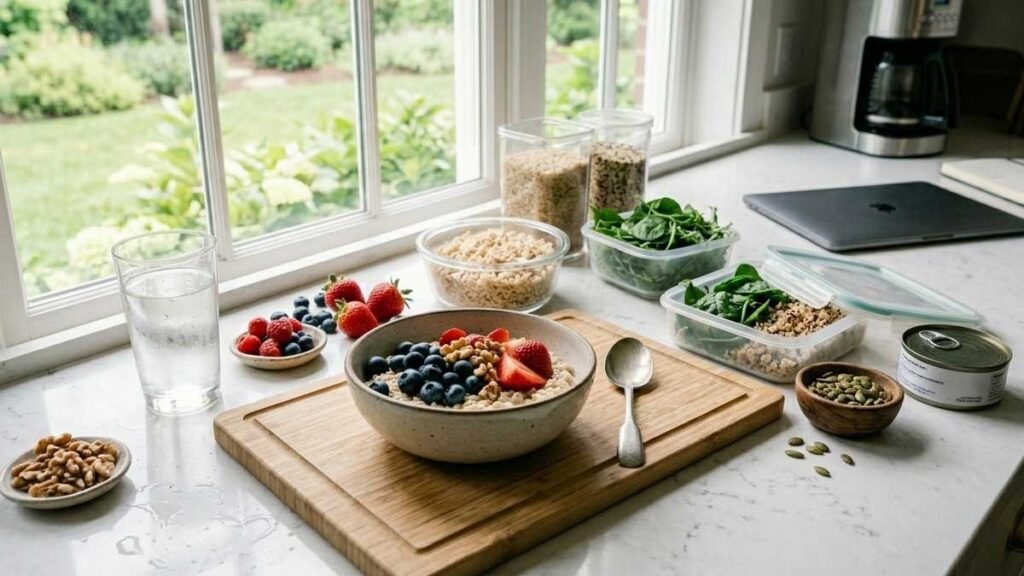
Oatmeal with berries and walnuts
This is one of the easiest workday breakfasts to recommend because it checks several boxes at once. Whole grains, berries, and nuts all fit naturally within the MIND-style pattern highlighted by NIA, and oats are an easy staple that most readers can actually keep in the kitchen.
It also works in real life. Five minutes, one bowl, very little cleanup, and no dramatic meal prep speech required.
Salmon, brown rice, and greens
This is the kind of lunch or dinner that quietly solves a lot of problems. Fish, whole grains, and leafy greens are all consistent with the eating patterns NIA describes for brain-supportive diets, while CDC and AHA guidance also point readers toward vegetables, whole grains, seafood, and minimally processed foods.
It is also easy to repeat, which matters more than people think. Repetition is a feature when your schedule is full.
Greek yogurt with berries and seeds
This is a smart option for breakfast, a desk snack, or a lighter lunch add-on. It combines fruit with a more substantial base, and seeds are an easy way to make the snack feel more intentional rather than improvised. CDC’s current nutrition guidance includes dairy without added sugars, fruits, nuts, and seeds as parts of a healthy eating pattern.
In other words, this is the kind of snack that helps you keep working instead of making you go hunting for something else 40 minutes later.
Whole-grain toast with eggs and spinach
This is a strong example of a practical breakfast or quick lunch built around real ingredients. Whole grains and leafy greens fit the broader pattern discussed by NIA and AHA, and eggs are also included in CDC’s healthy eating guidance as a protein option.
More importantly, it feels like actual food. That sounds obvious, but a lot of poor workday eating happens because meals stop feeling like meals.
Tuna wrap with greens and a side of fruit
This one works especially well for office lunches because it is portable, familiar, and easy to assemble. Fish, greens, fruit, and a whole-grain wrap line up well with the same larger pattern: more whole foods, more produce, and more meals that are built instead of improvised.
That is really the recurring theme of this article. Better focus during long workdays is often less about chasing a miracle ingredient and more about making your regular meals a little harder to mess up.
Simple Tips to Eat Better During Mentally Demanding Days
The good news is that eating better during long workdays usually does not require a dramatic diet overhaul. The broader pattern in current CDC, NIA, and American Heart Association guidance is fairly simple: build more meals around vegetables, fruits, whole grains, nuts, seeds, beans, fish, and other minimally processed staples, while keeping added sugars, excess sodium, and heavily processed foods more limited.
Build one better breakfast
A lot of poor workday eating starts early. If breakfast is too sugary, too small, or missing entirely, the rest of the day tends to become one long snack emergency. A better breakfast does not need to be impressive. Oatmeal with berries and walnuts, whole-grain toast with eggs and spinach, or Greek yogurt with berries and seeds are all simple examples that line up well with the kinds of foods emphasized in brain-supportive and heart-healthy eating patterns.
Keep one emergency snack nearby
This tip sounds small, but it saves a surprising number of afternoons. If your only nearby option is candy, chips, or a pastry, that is what will happen when energy drops. Keeping something simple like unsalted nuts, seeds, fruit, or a yogurt cup close by makes it much easier to stay inside a healthier eating pattern without needing extra willpower. CDC and AHA guidance both point people toward these kinds of minimally processed foods more often.
Do not let lunch become an afterthought
Lunch is where many workdays go off the rails. Either it gets skipped, or it turns into whatever is fastest and saltiest. A more useful default is a lunch built around a protein, a whole grain, and some produce. Think tuna in a whole-grain wrap with fruit, salmon with brown rice and greens, or a grain bowl with beans and vegetables. That kind of meal fits much better with the food patterns highlighted by NIA, CDC, and AHA than a heavy processed lunch or random snack combo.
Prep two or three workday staples in advance
You do not need a full meal-prep lifestyle. You just need a few things ready. Cook some brown rice or quinoa, wash berries, keep greens in the fridge, and stock canned tuna or salmon. That is enough to make several better meals during the week without turning Sunday into a food logistics operation. Practical repetition matters because the best workday food is usually the one that is already there when you are busy. That is not a government guideline. That is just real life. Still, it works especially well because those staple foods match the larger healthy eating patterns recommended by official sources.
Keep caffeine in its place
Coffee can absolutely fit into a healthy routine. The American Heart Association notes that water should be your main drink throughout the day, and that unsweetened tea and coffee can also fit into a healthy eating pattern. The key is not using caffeine as a substitute for actual meals. Two coffees and a pastry is not a strategy. It is just breakfast avoidance with branding.
FAQs
What are the best foods for brain health during long workdays?
Some of the most practical choices are fatty fish, berries, nuts and seeds, leafy greens, and whole grains. These foods closely match the MIND-style eating pattern described by the National Institute on Aging, which emphasizes vegetables, especially leafy greens, berries, whole grains, beans, nuts, fish, and olive oil.
What should I eat for focus and concentration at work?
A good rule is to build meals around real, minimally processed foods that help you stay steady instead of swinging between cravings and crashes. Oatmeal with berries and walnuts, Greek yogurt with seeds, a tuna wrap with fruit, or salmon with brown rice and greens are all solid examples. They line up with broader healthy eating guidance from CDC and AHA.
Are nuts and berries good for mentally demanding work?
They can be a very practical part of a better workday eating routine. Nuts fit the MIND pattern, and berries are specifically favored over other fruits in that eating style. They are also easy to pack, easy to portion, and much more useful than many sugary office snacks.
What is a good lunch for long office hours?
A good lunch should feel balanced, not heavy. A simple formula is protein + whole grain + produce. Examples include salmon with rice and greens, a tuna wrap with a side of fruit, or a grain bowl with beans and vegetables. That approach fits the general food patterns recommended by CDC and AHA.
Do whole grains help support steadier energy during the day?
Whole grains are often a smarter base than highly refined carb options because they are part of the healthy eating patterns recommended by CDC, AHA, and NIA. They are not a magic fix, but they can be a better everyday choice when you want a more dependable breakfast or lunch foundation.
What foods should I avoid during mentally demanding work?
It usually helps to limit foods that are high in added sugars or heavily processed, especially when they replace real meals. CDC guidance specifically recommends eating patterns that are low in added sugars and sodium, while AHA also recommends limiting sweetened drinks and processed foods.
Final Thoughts
If you spend long hours doing mentally demanding work, your meals do not need to be perfect. They just need to stop working against you.
That is really the whole point here. Better focus during long workdays is rarely about one miracle ingredient. It is usually about a few smarter defaults that show up again and again: more fish, more berries, more nuts and seeds, more leafy greens, and more whole grains. Those foods align closely with broader healthy eating patterns recommended by NIA, CDC, and the American Heart Association, and they are practical enough to use in normal life, not just in theory.
Start with one better breakfast. Keep one better snack nearby. Fix lunch before lunch becomes a problem. That is usually enough to make the second half of your workday feel a lot less chaotic.
And honestly, that may be the most underrated productivity habit of all.