



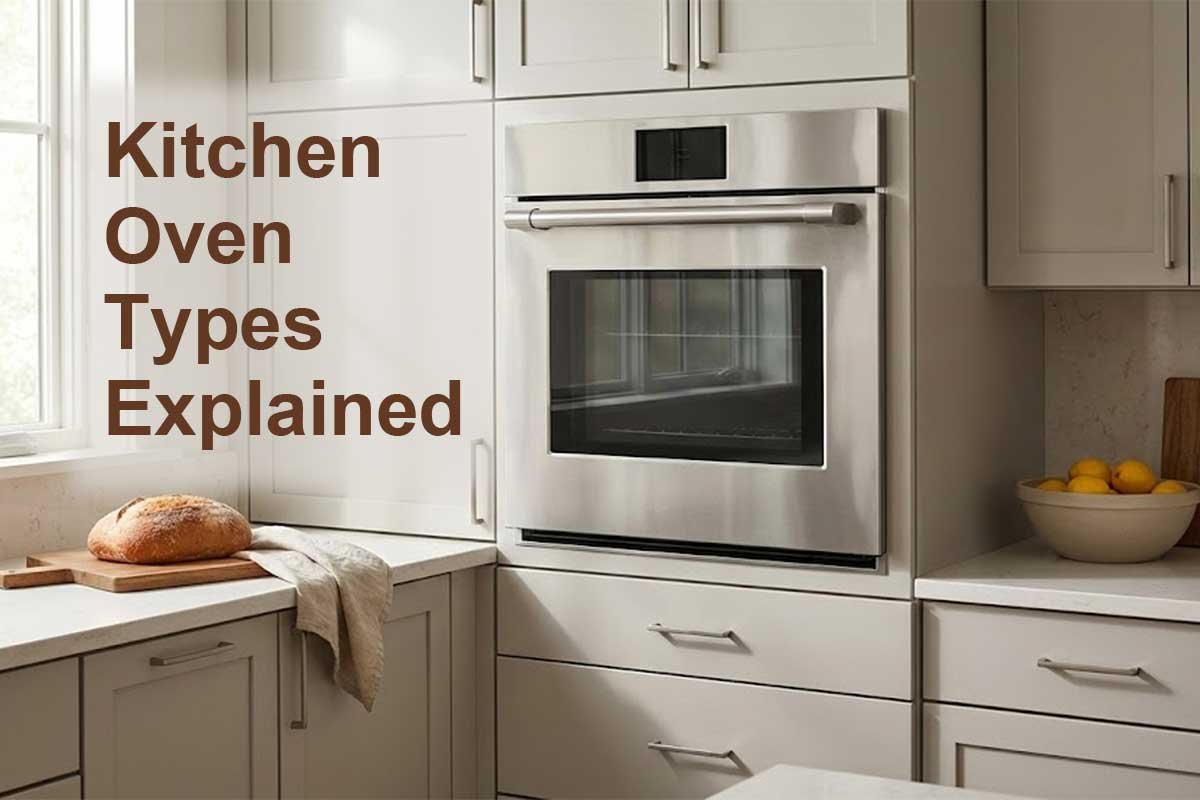
Choosing between different kitchen oven types isn’t just about space or budget—it directly affects how you cook, how your kitchen functions, and how much flexibility you’ll have over the next decade. Many homeowners focus on brand names first, but the real decision starts with configuration: single or double, built-in or freestanding, compact or full-size.
And here’s the truth most people don’t realize: the oven type often matters more than the model itself.
Before you compare specific models from our guide to the best kitchen ovens, it’s essential to understand how each oven configuration changes daily cooking. A double oven can completely transform holiday hosting. A built-in wall oven can improve ergonomics and kitchen flow. A freestanding range might offer the most practical solution for smaller homes.
Each type comes with trade-offs—installation requirements, cost differences, energy use, and long-term flexibility. Some are ideal for large families who cook daily. Others are better suited for apartments or occasional home cooks.
In this guide, we’ll break down every major oven configuration used in U.S. kitchens today. You’ll see real-world cooking scenarios, installation considerations, cost comparisons, and performance differences. And if you’re still deciding between fuel types, you may also want to compare gas vs electric ovens before finalizing your layout.
Let’s start with the foundational overview.
Main Kitchen Oven Types Explained
Understanding the core kitchen oven types helps eliminate confusion immediately. While brands and features vary, most ovens fall into a few structural categories.
Single Oven
A single oven is the most common configuration in U.S. homes. It typically comes in a 30-inch width and offers enough interior capacity for everyday cooking—baking, roasting, broiling, and reheating.
Single ovens can be:
- Freestanding (part of a range)
- Built-in wall ovens
- Slide-in designs
For most households, a single oven provides the best balance of capacity, cost, and simplicity. If you don’t regularly cook multiple dishes at different temperatures, a single oven is often more than enough.
Before choosing, however, always confirm cabinet compatibility using standard oven sizes and dimensions. Cutout measurements matter more than people expect.
Double Oven
Among modern kitchen oven types, double ovens feature two separate cavities stacked vertically (in wall installations) or combined in a freestanding range format.
The biggest advantage? Flexibility.
You can:
- Roast a turkey at 375°F while baking pies at 325°F
- Cook dinner in one cavity and dessert in the other
- Use the smaller top oven for quicker weekday meals
For large families or frequent hosts, a double oven isn’t a luxury—it’s a workflow upgrade. However, they require more vertical space and a higher upfront investment.
Wall Oven (Built-In)
Wall ovens are installed directly into cabinetry, typically at eye level. They separate the oven from the cooktop, giving you design flexibility and ergonomic comfort.
Benefits:
- No bending to access food
- Cleaner, built-in appearance
- Better integration in custom kitchens
Wall ovens are common in remodels and new construction projects. They’re often paired with separate gas or induction cooktops.
If you’re leaning toward this setup, fuel type still matters—compare gas vs electric ovens before committing to electrical or gas hookups.
Freestanding Range Oven
This is the traditional setup among modern kitchen oven types: a cooktop on top and the oven below, making it the most common and cost-effective configuration in U.S. homes.
Why it remains popular:
- Easier installation
- Lower overall purchase cost
- Simple replacement process
For many homes, especially mid-size kitchens, a freestanding range remains the most practical solution.
Slide-In & Drop-In Ovens
These designs offer a more integrated appearance than traditional freestanding ranges. Slide-in ovens sit flush with countertops, creating a semi-built-in look without full cabinetry modification.
They’re ideal if you want aesthetic improvement without major remodeling costs.
Combination Ovens (Microwave + Oven)
Combination wall ovens integrate a microwave above a traditional oven cavity. This configuration saves space and centralizes cooking functions.
They work well in compact kitchens or minimalist layouts but limit flexibility compared to two full oven cavities.
Quick Reality Check
Before deciding on configuration alone, also consider:
- Cooking frequency
- Household size
- Kitchen layout
- Electrical capacity
- Budget
And once structure is clear, features matter next. If you’re unsure which modes are truly useful, review common oven features explained to avoid paying for marketing extras you won’t use.
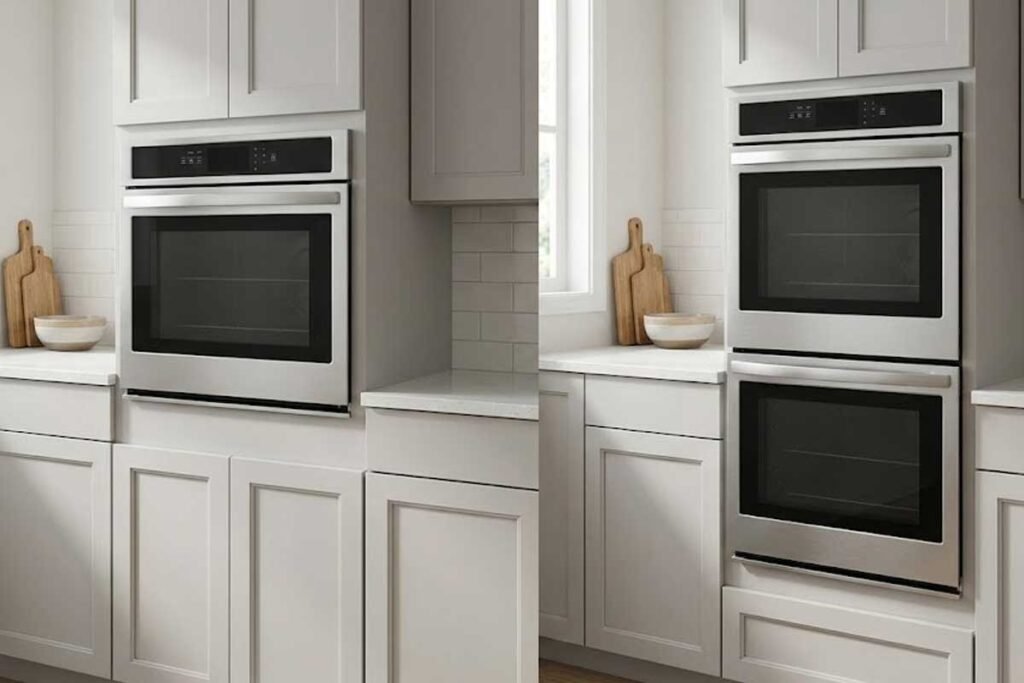
Single vs Double Oven – Real Cooking Scenarios
When comparing kitchen oven types, the single vs double oven debate is where theory meets real life. On paper, a double oven sounds like a luxury. In practice, it can either be a game-changer—or unnecessary overkill. The difference becomes clear when you look at actual cooking situations.
Thanksgiving Dinner: The Stress Test
Let’s start with the classic American stress test—Thanksgiving.
With a single oven, everything must rotate. The turkey dominates the cavity for hours. Stuffing waits. Pies get baked late. Side dishes reheat at the last minute. Timing becomes choreography.
With a double oven, you immediately unlock flexibility:
- Turkey cooks in the lower cavity.
- Pies bake simultaneously in the upper oven.
- Side dishes stay warm without temperature compromises.
You’re not just saving time—you’re reducing stress. For families who host large holiday meals multiple times per year, a double oven becomes less of a luxury and more of a workflow tool.
However, if you only host once a year, that extra cavity may sit unused most of the time.
Weekly Family Meal Prep
Now shift to a typical weeknight.
If you cook dinner daily for four or five people, a double oven allows:
- Roasting vegetables in one oven
- Baking protein in another
- Running different temperatures simultaneously
This is especially useful if you meal prep—cooking several dishes at once for the week ahead.
But here’s the nuance: many modern single ovens with strong convection systems handle multi-rack cooking extremely well. Before upgrading, consider whether improved airflow (see what a convection oven is) could solve the capacity issue without adding a second cavity.
For smaller households or couples, a single 30-inch oven often provides more than enough space.
Baking Weekends
If you bake regularly—cookies, breads, cakes—a double oven can be incredibly efficient among modern kitchen oven types. One cavity can maintain a lower temperature for proofing dough while the other handles active baking.
That said, capacity matters just as much as cavity count. Some large single ovens offer over 5.5 cubic feet of interior space. In many cases, a spacious single oven performs just as well as two smaller stacked cavities.
Before deciding, verify interior capacity using standard oven sizes and dimensions, not just exterior width.
Entertaining & Holiday Hosting
Frequent entertainers benefit most from double ovens. You gain temperature independence, staggered cook times, and better control when juggling multiple dishes.
Many double ovens also include advanced modes and programmable timers. If you’re evaluating feature differences, our guide to common oven features explained breaks down what’s genuinely useful versus marketing fluff.
When a Double Oven Is Overkill
A double oven may not make sense if:
- You cook simple meals
- You rarely host
- Your kitchen has limited vertical cabinet space
- Budget is tight
Double ovens cost more upfront, require more installation space, and may increase electrical load requirements. When comparing different kitchen oven types, many households find that a high-quality single oven from our list of the best kitchen ovens delivers all the performance they actually need.
The Real Decision
Ask yourself:
- Do I cook multiple dishes at different temperatures often?
- Do I host large gatherings regularly?
- Is kitchen space available for a stacked installation?
If the answer is “rarely,” a single oven is probably the smarter investment. If the answer is “almost every week,” a double oven starts to justify its cost.
The goal isn’t bigger—it’s appropriate.
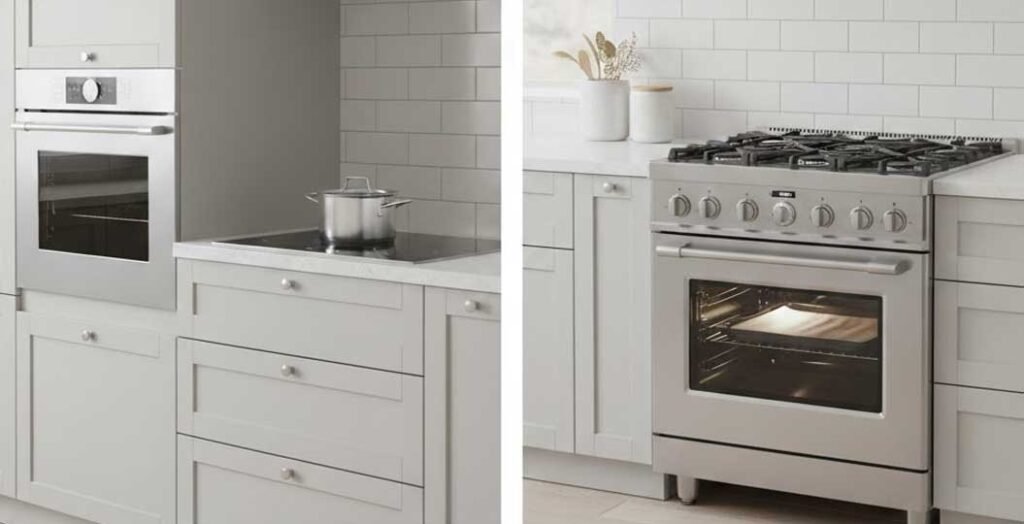
Built-In vs Freestanding Ovens – Kitchen Design & Flexibility
When evaluating kitchen oven types, one of the biggest structural decisions isn’t single vs double—it’s built-in vs freestanding. This choice affects layout, ergonomics, installation complexity, and even future renovation flexibility.
At first glance, freestanding ovens (ranges) appear simpler. They combine cooktop and oven into one appliance, slide into a standard 30-inch opening, and connect to existing gas or electric lines. For many households, especially in established homes, this is the most practical and cost-effective solution. Replacement is straightforward. If your current range fails, you can usually swap it without modifying cabinetry.
Built-in ovens, on the other hand, are integrated directly into kitchen cabinetry—typically at eye level. This configuration separates the oven from the cooktop, which may be installed elsewhere on the counter. The result is a cleaner, more custom look and improved ergonomics. No bending to lift heavy roasts. Easier monitoring while baking. A smoother kitchen workflow.
However, built-in installations require planning. Cabinet cutouts must be precise. Electrical requirements may differ. If you’re considering switching fuel type at the same time, review gas vs electric ovens before committing to cabinetry modifications.
Remodeling vs Existing Layout
Among the most design-friendly kitchen oven types, built-in wall ovens stand out if you’re remodeling or building a new kitchen, offering long-term flexibility and visual appeal. They integrate seamlessly into modern cabinetry and pair well with induction or gas cooktops.
If your kitchen is already designed around a freestanding range, switching to a wall oven may involve:
- New cabinet construction
- Countertop adjustments
- Electrical or gas relocation
- Ventilation modifications
That adds cost quickly.
Ergonomics & Daily Comfort
Eye-level wall ovens are one of the most ergonomic kitchen oven types, reducing strain and improving safety—especially for older homeowners or frequent cooks handling heavy dishes.
Freestanding ovens, while lower to the ground, offer convenience in compact kitchens where space is limited.
Long-Term Flexibility
Freestanding ranges are easier to replace. Built-in ovens lock you into specific cutout sizes—meaning future replacements must match existing dimensions. That’s why checking oven sizes and dimensions before installing a wall oven is critical.
The Design Decision
Choose freestanding if:
- You want simplicity and lower cost
- You prefer minimal remodeling
- Your kitchen is mid-size or compact
Choose built-in if:
- You’re remodeling
- Ergonomics matter
- You want a premium, integrated appearance
Layout first. Features second. Brands last.
Installation & Space Requirements
Choosing between different kitchen oven types becomes very real the moment measurements come out. Installation isn’t just about sliding an appliance into place—it involves cabinet cutouts, electrical load, gas connections, ventilation, and long-term service access. Overlooking these details is one of the most expensive mistakes homeowners make.
Standard 30-Inch Installations
In the United States, the 30-inch width is the industry standard for both freestanding ranges and most wall ovens. This width fits the majority of existing kitchen layouts and cabinetry. If you’re replacing an older oven without remodeling, sticking with a 30-inch model dramatically simplifies installation.
Freestanding ranges are typically the easiest to install. They slide into a standard opening and connect to existing power or gas lines. Minimal cabinetry modification is required.
Wall ovens, however, require precise cabinet cutouts. Height, depth, and ventilation clearances must match manufacturer specifications exactly. Before purchasing, always verify measurements using our detailed guide on oven sizes and dimensions to avoid costly returns or cabinet reconstruction.
24-Inch & Compact Installations
Smaller kitchens, apartments, and condos often use 24-inch ovens. These require narrower cabinet openings and may offer slightly reduced interior capacity. While compact models save space, they limit future replacement options compared to the widely supported 30-inch standard.
If long-term flexibility matters, this is worth considering.
Stacked Double Wall Ovens as a Premium Kitchen Oven Type
Among all modern kitchen oven types, stacked double wall ovens are the most space-intensive but also the most flexible configuration for serious home cooks. These units are installed vertically inside cabinetry and require significant cabinet height—often exceeding 50 inches depending on the model. Because you’re working with two separate oven cavities, structural cabinet support is critical. These appliances are heavy, and proper reinforcement ensures long-term stability and safe operation.
Electrical requirements are also more demanding. Most stacked double wall ovens require a dedicated 240V circuit and higher amperage than a standard single oven. In older homes, this may mean upgrading your electrical panel—an added cost many homeowners overlook during planning.
Before installation, always confirm cabinet cutout measurements and electrical capacity. Unlike freestanding units, stacked wall ovens leave little margin for measurement error. Precision planning upfront prevents expensive adjustments later.
Gas vs Electric Hookups
Gas ovens require:
- A properly installed gas line
- Shut-off valve access
- Professional installation in most cases
Electric ovens require:
- 240V outlet
- Correct breaker amperage
- Proper grounding
If you’re still deciding between fuel types, review gas vs electric ovens before planning installation. Switching fuel sources mid-renovation can significantly increase costs.
Ventilation & Clearance
All kitchen oven types need adequate ventilation and clearance space to prevent overheating. Built-in models must follow strict manufacturer spacing guidelines to avoid damaging surrounding cabinetry.
Proper airflow improves:
- Safety
- Performance
- Appliance longevity
Skipping clearance requirements to “make it fit” is never worth it.
Service Access & Future Replacement
Another overlooked factor is accessibility. If your oven needs service in 8–10 years, will technicians be able to remove it easily? Built-in units require careful extraction; freestanding ranges are far simpler.
Installation decisions should always consider:
- Present fit
- Electrical capacity
- Future replacement flexibility
- Long-term home value
Measure twice. Confirm electrical specs. Then buy.
Cost Comparison – Purchase + Installation
When comparing different kitchen oven types, price tags can be misleading. The number you see online is only part of the equation. True cost includes purchase price, installation, possible electrical upgrades, cabinetry adjustments, and long-term operating expenses. Understanding the full financial picture helps prevent unpleasant surprises.
According to the U.S. Department of Energy, oven efficiency and cooking habits both influence long-term energy use.
Entry-Level Single Ovens
Different kitchen oven types require different installation planning, especially when it comes to electrical capacity and cabinet dimensions.
A standard 30-inch freestanding single oven (range) is typically the most affordable configuration. Entry-level models are widely available and easy to install, especially if you’re replacing an existing unit of the same size and fuel type.
Installation costs are usually minimal:
- Basic electric hookup
- Existing gas connection
- No cabinet modification
For budget-conscious buyers, this setup offers the strongest value-to-performance ratio—especially when selecting from the best kitchen ovens in the mid-range category.
Mid-Range Wall Ovens
Built-in wall ovens cost more upfront than freestanding ranges. You’re paying for:
- Separate appliance design
- Cabinet integration
- Often better materials and display panels
Installation adds to the expense:
- Precise cabinet cutouts
- Dedicated electrical circuits
- Professional installation
Many mid-range models now include convection systems. If you’re unsure whether that upgrade is worth the extra investment, review what a convection oven is before deciding. In many cases, convection improves performance enough to justify the price difference.
Double Oven Pricing
Among premium kitchen oven types, double ovens represent a clear step up in cost. You’re essentially purchasing two cooking cavities in one unit, which means higher purchase prices and increased installation complexity.
Additional considerations:
- Higher electrical load requirements
- Potential panel upgrades in older homes
- Taller cabinet construction
However, for large families or frequent hosts, the efficiency and flexibility can offset the higher initial investment over time.
Gas Installation Costs
Gas ovens may carry lower operating costs in certain regions, but installation can be more expensive if:
- A gas line must be extended
- Shut-off valves need updating
- Professional gas fitting is required
Before choosing based on energy price alone, compare long-term use in our breakdown of gas vs electric ovens.
Electrical Upgrade Costs for Different Kitchen Oven Types
Electric ovens—especially double wall ovens—often require a 240V circuit with sufficient amperage. If your home’s electrical panel lacks capacity, upgrading it can add several hundred to a few thousand dollars to the total project.
This is why installation planning must happen before purchase.
Long-Term Operating Costs
Operating costs vary by:
- Fuel prices in your state
- Insulation efficiency
- Cooking frequency
- Convection usage
While the differences aren’t extreme, electric ovens tend to offer more stable heat control, which can reduce overcooking and energy waste.
The Bottom Line on Cost
Freestanding single ovens = lowest upfront cost
Wall ovens = mid-tier investment
Double ovens = highest upfront + installation cost
The smartest decision balances:
- How often you cook
- Your kitchen layout
- Long-term flexibility
- Total installation expenses—not just sticker price
Performance Differences by Oven Type
When comparing kitchen oven types, performance differences often come down to airflow, heat distribution, cavity size, and configuration—not just brand reputation. Two ovens with similar price tags can cook very differently depending on their structural design.
You can also check ENERGY STAR certified models for improved energy performance.
Heat Consistency
Single ovens—especially electric convection models—tend to offer the most stable temperature control. Because there’s only one cavity to manage, the heating elements and sensors can regulate heat more evenly.
Double ovens split heating into two separate compartments. While this adds flexibility, smaller upper cavities sometimes heat faster but may have slightly different airflow patterns. Lower cavities, typically larger, may perform differently depending on insulation and element placement.
Understanding how an oven works helps explain these differences. Heating elements cycle on and off, sensors regulate temperature, and convection fans move hot air. The more efficiently these components interact, the more consistent the cooking experience.
Multi-Rack Cooking
Double ovens excel when cooking multiple dishes at different temperatures. However, a high-quality convection single oven can handle multi-rack baking nearly as well—especially if it uses true convection (fan + rear heating element).
If baking is your priority, airflow design often matters more than cavity count.
Preheat Speed
Gas ovens typically preheat faster due to direct flame heating. Electric ovens may take slightly longer but provide more consistent internal temperature once heated.
Compact ovens often preheat faster simply because the cavity is smaller.
Energy Efficiency
Single ovens generally consume less energy than double ovens, simply because there’s only one cavity to heat. However, running a smaller upper oven in a double unit may use less energy than heating a large single cavity for small meals.
Efficiency also depends on insulation quality and smart temperature regulation.
Smart Features & Control Systems
Modern ovens increasingly rely on digital control boards and sensors. Higher-end built-in ovens may offer:
- More accurate temperature calibration
- Integrated probes
- Advanced convection modes
For a deeper breakdown of useful modes versus marketing hype, review common oven features explained before prioritizing feature lists.
Kitchen oven types Performance Reality Check
The best-performing oven type depends on:
- Cooking frequency
- Meal size
- Need for simultaneous temperature control
- Airflow design
A well-designed single convection oven can outperform a poorly insulated double oven. Configuration matters—but engineering matters more.
By now, you’ve seen how different kitchen oven types impact cooking performance, installation complexity, space planning, and long-term costs. Choosing between these configurations isn’t about trends—it’s about matching the oven structure to your daily habits.
Frequently Asked Questions About Kitchen Oven Types
Is a double oven worth it for most homes?
A double oven is worth it if you frequently cook multiple dishes at different temperatures or host large gatherings several times a year. For large families and holiday-heavy households, the flexibility can significantly reduce stress and cooking time. However, for smaller households or occasional cooks, a high-quality single convection oven often provides more than enough capacity without the added cost or installation complexity.
Can you replace a single oven with a double oven?
It depends on cabinet space and electrical capacity. Double wall ovens require significantly more vertical cabinet height and may need a dedicated 240V circuit with higher amperage. In many existing kitchens, replacing a single oven with a double requires cabinet modification and possibly electrical upgrades.
Are built-in ovens more expensive than freestanding ranges?
Yes, built-in wall ovens generally cost more upfront and may require additional installation work. However, they offer better ergonomics, cleaner kitchen design, and greater flexibility when paired with separate cooktops. The higher price often reflects installation complexity and premium build quality.
What is the most common oven type in the United States?
The most common configuration in U.S. homes is a 30-inch freestanding single oven range. This setup offers the best balance between cost, ease of installation, and cooking capacity for the average household.
Do double ovens use more electricity?
Double ovens can use more electricity if both cavities operate simultaneously. However, using only the smaller upper cavity for everyday meals may consume less energy than heating a large single oven. Energy use ultimately depends on cooking habits and insulation efficiency.
Is convection necessary for modern ovens?
Convection is not mandatory, but it is highly recommended. It improves heat distribution, reduces cooking time, and produces more consistent baking results. In 2026, most mid-range ovens include convection as a standard feature.
Which Kitchen Oven Types Are Best for Your Home?
After comparing all major kitchen oven types, the right choice becomes less about “best overall” and more about “best for your lifestyle.”
Best for Small Kitchens or Apartments
A standard 30-inch freestanding single oven—or even a compact 24-inch model—offers sufficient capacity without overwhelming the space. Installation is simpler, and replacement flexibility is greater.
Best kitchen oven typesfor Large Families
Double ovens shine in busy households where multiple dishes cook simultaneously. Holiday hosting, weekly meal prep, and baking-heavy routines justify the added investment.
Best for Frequent Bakers
Choose a high-quality electric convection oven. Even airflow and stable temperatures matter more than having two cavities. If you’re still comparing performance differences, explore our recommendations for the best kitchen ovens to see which models stand out.
Best for Remodel Projects
Built-in wall ovens create ergonomic advantages and a premium kitchen aesthetic. However, confirm cutout compatibility using oven sizes and dimensions before finalizing cabinetry.
Best kitchen oven types for Budget-Conscious Buyers
A mid-range single oven delivers strong performance without installation complications. In many cases, upgrading to convection is a smarter investment than upgrading to a second cavity.
The Final Decision Filter
Ask yourself:
- How often do I cook multiple dishes at different temperatures?
- Am I remodeling or replacing?
- Does my electrical panel support upgrades?
- Will I realistically use a second oven cavity?
Configuration first. Features second. Fuel type third. Brand last.