




You open the dishwasher expecting spotless glasses—only to find cloudy cups, food stuck to bowls, and water spots everywhere. If you’re dealing with a dishwasher not cleaning top rack, the frustration feels immediate, especially when the bottom rack looks perfectly fine.
You’re not alone. This is one of the most common and confusing problems homeowners face. The dishwasher seems to be working normally. It fills. It drains. It runs a full cycle without flashing error codes. Yet somehow, the upper rack still comes out dirty.
That contrast—clean plates below, dirty glasses above—isn’t random. It usually points to a specific issue inside the machine, not a total failure. And in most cases, it’s fixable without replacing the appliance.
Here’s the good news: in most cases, this problem is fixable. It rarely means the dishwasher is completely broken. More often, it comes down to water flow, spray arm performance, loading habits, or simple maintenance issues that build up over time.
Before you assume the worst—or start shopping for a replacement—it helps to understand how water actually moves inside your machine. If you need a quick refresher, here’s a breakdown of how a dishwasher works and how water is distributed during a cycle.
In this guide, we’ll walk through the most common causes behind top rack cleaning failures, explain why they happen, and show you step-by-step fixes you can try right away. By the end, you’ll know whether you’re dealing with a quick maintenance task—or something that requires repair.
Let’s start with the big picture.
Why Is My Dishwasher Not Cleaning the Top Rack?
When only the top rack is coming out dirty, that detail matters. It tells us something specific: the dishwasher is operating—but water isn’t reaching the upper rack with enough pressure or consistency.
In other words, this isn’t a general cleaning failure. It’s usually a water distribution problem.
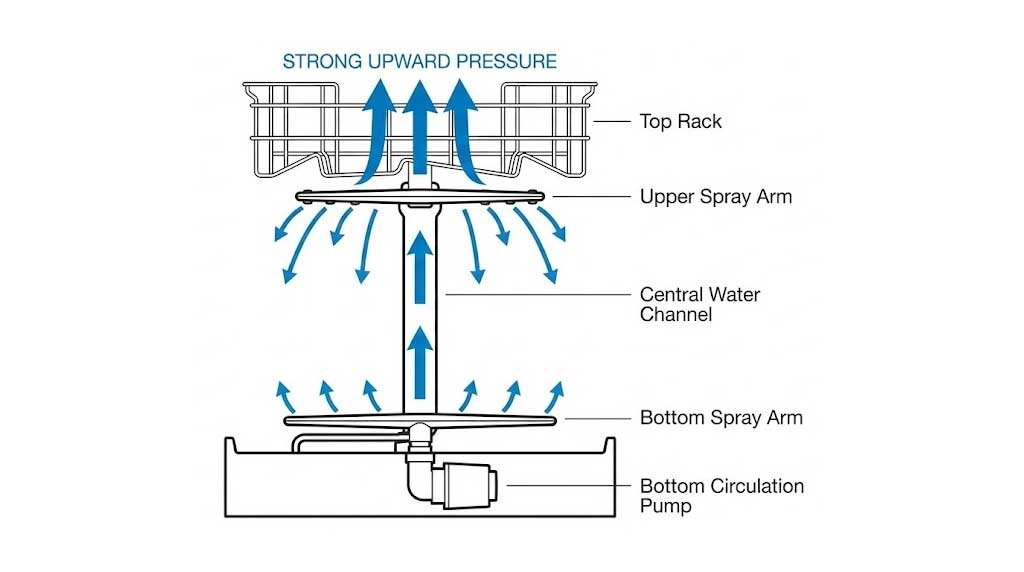
Most dishwashers clean in layers. Water is pumped from the bottom of the tub, forced through spray arms, and redirected upward through a circulation system. If any part of that path is restricted, the upper rack is often the first place you’ll see symptoms.
Here are the most common causes:
- A blocked or clogged upper spray arm
- Weak water pressure or flow restrictions
- Dirty or clogged filters reducing circulation
- A failing circulation pump
- Improper loading that blocks spray coverage
- Detergent or hard water issues
Notice something important here: most of these causes are mechanical or maintenance-related—not catastrophic failures.
That’s why it’s critical to diagnose systematically.
Instead of guessing, start by asking:
- Are glasses cloudy but plates below are spotless?
- Do you hear unusual humming or weak spray sounds?
- Has performance slowly declined over time?
- Did the problem start suddenly after a heavy load?
The pattern tells you where to look first.
Now let’s move into the most common—and most fixable—cause.
Most Common Cause #1 – Blocked or Not Spinning Spray Arm
If there’s one place to start, it’s here.
The upper spray arm is responsible for distributing pressurized water across the top rack. If it can’t spin freely or if its spray holes are clogged, water simply won’t reach your glasses and bowls with enough force to clean them properly.
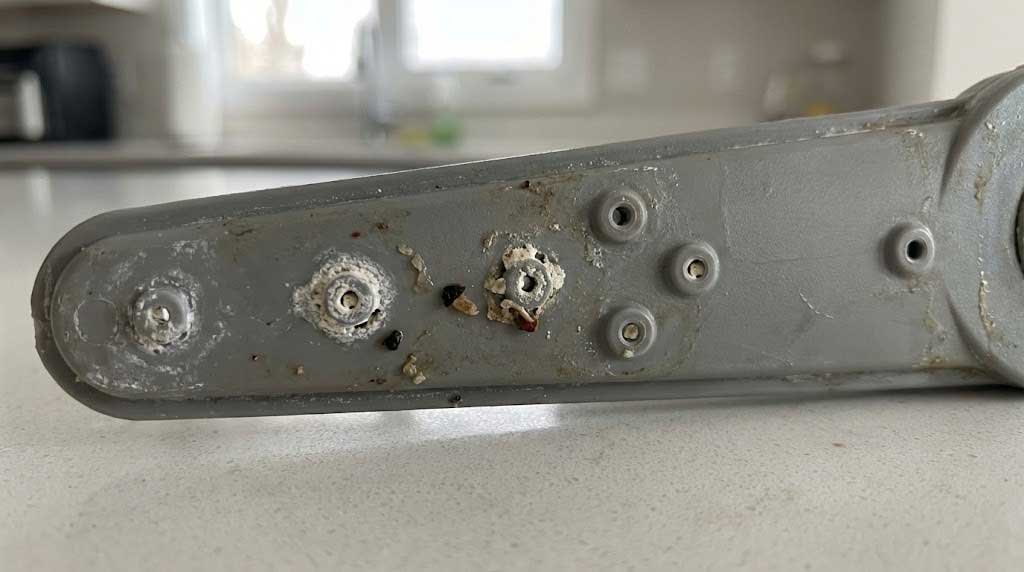
Over time, tiny food particles, mineral deposits, and detergent residue can block the spray holes. In hard water areas, this buildup happens even faster. And if something physically obstructs the arm—like a tall utensil or improperly loaded plate—it may not rotate at all during the cycle.
Here’s why that matters:
Dishwashers rely on rotating spray arms to create full coverage. If the arm doesn’t spin, water sprays in one limited direction. The result? Uneven cleaning—and a dirty top rack.
How to Check the Top Spray Arm
Start simple.
- Remove the upper rack (most slide out fully or lift off the track).
- Locate the spray arm underneath or above it, depending on your model.
- Try spinning it by hand.
It should rotate smoothly and without resistance. If it feels stiff, wobbly, or stuck, that’s your first clue.
Next, inspect the spray holes closely. Even small debris can disrupt pressure.
How to Clean It Properly
If you see buildup:
- Remove the spray arm (most twist off or release with a clip).
- Rinse it under warm water.
- Use a toothpick or soft brush to clear each spray hole.
- Soak it in vinegar if mineral deposits are visible.
After cleaning, reinstall it securely and ensure it spins freely before running a test cycle.
If your dishwasher hasn’t been cleaned recently, this is also a good time to review how to clean your dishwasher properly, since internal buildup often affects more than just one component.
In many cases, this single step restores full cleaning performance.
Cause #2 – Low Water Pressure or Poor Water Flow
If the spray arm is clean and spinning freely but the top rack still comes out dirty, the next place to look is water pressure.
Dishwashers don’t rely on gravity to clean the upper rack. They rely on pressure. Water is forced upward through a circulation system. If that pressure drops—even slightly—the top rack suffers first.
And here’s what many homeowners don’t realize: the dishwasher can still complete a full cycle even with weak water flow.
It will fill. It will drain. It will hum. But the cleaning power won’t be there.
What Causes Low Water Flow?
There are several common culprits:
- Partially closed water supply valve
- Kinked or restricted inlet hose
- Clogged inlet screen
- Failing water inlet valve
- Mineral buildup inside the circulation channel
Each of these reduces how much water enters—or how forcefully it moves inside—the machine.
Signs You’re Dealing With Water Flow Issues
You might notice:
- Glasses feel dusty instead of rinsed
- Detergent residue remains on the top rack
- The dishwasher sounds quieter than usual
- Cleaning performance declined gradually
One quick check: run a cycle and listen closely during the wash phase. A healthy dishwasher has a strong, consistent spraying sound. If it sounds weak or uneven, pressure may be compromised.
How to Check the Water Supply
Start with the simplest possibility.
- Locate the shutoff valve under the sink.
- Make sure it’s fully open.
- Inspect the inlet hose for bends or pinches.
- If comfortable, disconnect the hose and check the inlet screen for debris.
If the water supply checks out but the problem persists, the issue may be internal—particularly with the circulation pump, which we’ll cover shortly.
But before assuming a mechanical failure, there’s another very common cause worth checking.
Cause #3 – Dirty or Clogged Filters
This one surprises people.
Dishwasher filters trap food particles to prevent them from recirculating. Over time, however, those trapped particles restrict water movement.
And because the upper rack depends on strong upward pressure, reduced circulation hits it hardest.
In other words, a dirty filter doesn’t always ruin the entire wash—it often shows up first as top rack underperformance.
Why Filters Affect the Top Rack More
Water is drawn from the bottom of the tub, pushed through the pump, and sent upward. If the filter is partially clogged:
- Water flow weakens
- Pressure drops
- Upper spray coverage decreases
The bottom rack may still look decent because it’s closer to the water source. The top rack, however, loses spray intensity first.
How to Remove and Clean the Filter
Most modern dishwashers have a removable filter at the bottom center of the tub.
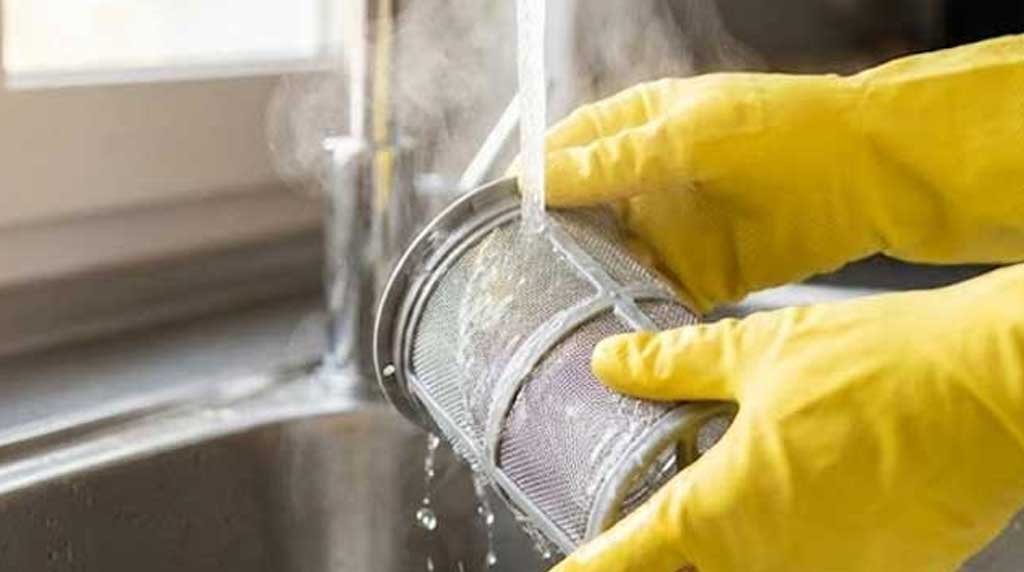
- Twist and lift the filter assembly.
- Rinse under warm running water.
- Use a soft brush to remove grease and debris.
- Inspect the filter housing for buildup before reinstalling.
If the filter hasn’t been cleaned in months—or ever—this step alone can dramatically improve performance.
Regular filter cleaning is part of basic maintenance. If you haven’t done a full service recently, reviewing proper dishwasher maintenance tips can prevent this issue from recurring.
In many cases, a clogged filter combined with a slightly obstructed spray arm creates the perfect storm for a dirty top rack.
Cause #4 – Circulation Pump Problems
If the spray arms are clean and the filters aren’t clogged, but the top rack still isn’t getting clean, the issue may be inside the circulation system.
The circulation pump is the heart of the dishwasher. It draws water from the bottom, pressurizes it, and pushes it through the spray arms. If that pump weakens, upper-rack performance drops first.
Why? Because the top rack requires stronger upward pressure to deliver proper coverage. The bottom rack is closer to the water source and often still gets enough force to appear clean.
Signs of a Weak or Failing Circulation Pump
Look (and listen) for:
- Dishes on the top rack coming out consistently dirty
- A quieter-than-usual wash sound
- Intermittent humming without strong spraying
- Cycles completing but cleaning declining gradually
Unlike clogged filters or blocked spray arms, pump issues tend to worsen over time rather than appear suddenly.
Can You Fix It Yourself?
Pump replacement is more advanced than cleaning a spray arm. It typically requires:
- Disconnecting power and water
- Removing the dishwasher from its cabinet
- Accessing the motor assembly underneath
For experienced DIYers, it’s possible. For most homeowners, this is the point where professional repair makes sense.
Before replacing anything, however, rule out the next cause — because it’s far more common and costs nothing to fix.
Cause #5 – Incorrect Loading Blocking the Spray
This is one of the most overlooked reasons the dishwasher isn’t cleaning the top rack — and it’s entirely preventable.
Even a perfectly functioning machine can fail to clean if water physically can’t reach the dishes.
Remember: dishwashers don’t soak dishes. They rely on rotating spray arms that shoot water in specific patterns. If tall plates, cutting boards, or oversized bowls block those patterns, water won’t reach the upper rack properly.
Common Loading Mistakes That Affect the Top Rack
- Large baking sheets on the bottom rack blocking upward spray
- Tall utensils positioned under the upper spray arm
- Bowls nested together on the top rack
- Items placed too tightly, preventing water circulation
The result? The spray arm may spin, but water can’t reach critical surfaces.
Why the Top Rack Suffers First
When water flow is partially blocked from below, the top rack gets weaker spray pressure. Glasses and mugs, which rely on direct spray entry, are especially vulnerable.
That’s why cloudy glasses on the top rack are often a loading problem—not a mechanical failure.
Quick Test
Run a cycle with:
- Fewer items
- No oversized plates
- Clear space beneath the upper rack
If cleaning improves immediately, loading was the issue.
Proper arrangement makes a bigger difference than most people think. If you’re unsure whether you’re blocking spray coverage, reviewing how to load a dishwasher the right way can completely change performance.
In many households, adjusting loading habits alone solves persistent top rack issues.
Cause #6 – Detergent or Rinse Aid Issues
If all mechanical components check out and loading isn’t the problem, the issue may come down to chemistry rather than hardware.
Modern dishwashers are engineered to work with specific detergent formulas. When the detergent is old, low quality, incompatible with your water type, or used incorrectly, cleaning performance drops—often first on the top rack.
Why the top rack?
Because glasses and lightweight items rely heavily on proper detergent activation and rinse aid performance. When detergent dissolves poorly or water softening is inadequate, residue and cloudiness show up there first.
Common Detergent-Related Problems
- Old or moisture-exposed detergent pods
- Too much or too little detergent
- Hard water mineral interference
- Rinse aid dispenser empty
Hard water is particularly relevant in many U.S. regions. Mineral buildup reduces cleaning power and leaves film on glassware, even if the dishwasher itself is functioning properly.
If you’re unsure whether detergent type may be affecting results, reviewing a dishwasher detergent comparison can help clarify which format works best in your environment.
In households with consistently hard water, machines specifically designed for mineral-heavy areas can perform better long term—something to keep in mind when evaluating performance trends.
Why Only the Top Rack Is Affected (Technical Explanation)
Understanding the water distribution hierarchy inside your dishwasher helps make sense of this issue.
Here’s how it typically works:
- Water collects at the bottom of the tub.
- The circulation pump pressurizes it.
- Water is forced through the lower spray arm.
- From there, it travels upward through a channel system.
- It powers the middle or upper spray arm.
If anything reduces pressure along that path—even slightly—the top rack receives less force.
That’s why:
- Clogged filters weaken upper cleaning first
- Pump inefficiency shows up on the top rack
- Blocked upward spray patterns affect glasses before plates
The bottom rack may still appear clean because it sits closest to the source of water pressure.
This layered system design explains why top rack issues are often early warning signs—not complete system failures.
Step-by-Step Troubleshooting Checklist
Before calling for service or replacing your dishwasher, work through this sequence.
Step 1 – Inspect the Upper Spray Arm
- Remove and clean it.
- Ensure it spins freely.
Step 2 – Clean the Filter
- Remove debris buildup.
- Reinstall securely.
Step 3 – Check Loading
- Remove tall or oversized items.
- Leave space for spray coverage.
Step 4 – Verify Water Supply
- Confirm shutoff valve fully open.
- Inspect inlet hose for kinks.
Step 5 – Test with Fresh Detergent
- Use a new pod or high-quality powder.
- Ensure rinse aid reservoir is filled.
Step 6 – Listen During a Cycle
- Strong spray sound = good pressure.
- Weak hum = possible circulation issue.
Run a controlled test cycle after completing these steps. In most cases, the issue is resolved before reaching Step 6.
When to Call for Repair
If the top rack remains dirty after completing all checks, the likely culprits are:
- Circulation pump failure
- Internal water distribution blockage
- Control board malfunction
Signs you need service:
- Persistent weak spray sound
- Repeated error codes
- Burning smell
- Dishwasher shutting off mid-cycle
At this stage, repair estimates can help determine the next move.
When It’s Time to Replace the Dishwasher
If your dishwasher is:
- 10+ years old
- Experiencing repeated circulation issues
- Requiring expensive motor or pump repairs
replacement may make more financial sense.
Newer models are significantly more efficient and often resolve chronic pressure-related problems entirely.
If you’re considering that route, reviewing current best dishwasher options for this year can help you compare modern improvements in spray systems and water distribution.
Dishwasher Not Cleaning Top Rack – FAQ
1) Why is my dishwasher only cleaning the bottom rack?
This usually means water pressure is not reaching the upper spray arm effectively. Common causes include clogged spray arm holes, dirty filters, blocked water channels, or improper loading that prevents upward spray coverage.
2) Can a clogged filter cause the top rack to stay dirty?
Yes. A clogged filter restricts water circulation. Because the top rack depends on strong upward pressure, it’s often the first area where reduced flow becomes visible.
3) Why are my glasses cloudy on the top rack?
Cloudy glasses are often caused by hard water deposits, weak spray pressure, or detergent issues. When water doesn’t reach the upper rack with enough force, residue remains on glassware.
4) Does low water pressure affect the top rack more?
Yes. The top rack requires sufficient circulation pressure to distribute water evenly. If pressure drops, the bottom rack may still appear clean while the top rack does not.
5) Should I replace my dishwasher if only the top rack is dirty?
Not immediately. In most cases, the issue is maintenance-related. Replacement should only be considered if the dishwasher is over 10 years old and mechanical components like the circulation pump have failed.
6) How do I know if the circulation pump is failing?
Signs include weak spraying sounds, incomplete cleaning even after maintenance, repeated performance decline, or unusual humming during wash cycles.
Final Thoughts
A dishwasher not cleaning the top rack can feel like a major problem—but most of the time, it isn’t.
In the majority of cases, the issue comes down to:
- Blocked spray arms
- Dirty filters
- Loading mistakes
- Minor water flow restrictions
True mechanical failures are less common than people assume.
The key is systematic diagnosis. Start simple. Eliminate the easy causes first. Only escalate to repair or replacement if performance doesn’t improve.
With the right troubleshooting approach, many top rack issues can be resolved in under an hour—without spending a dollar on parts.