



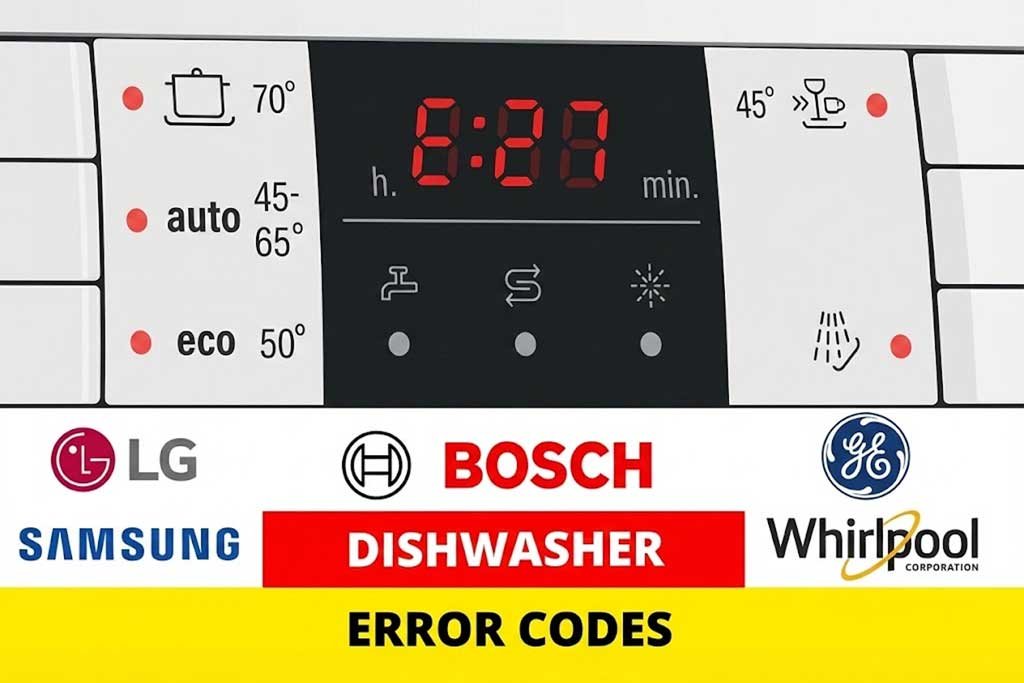
Dishwasher error codes explained—if you’ve ever started a wash cycle only to hear a beep, see blinking lights, or spot a cryptic code on the display, you’re not alone. For many U.S. homeowners, dishwasher error codes are one of the most common reasons a perfectly normal day in the kitchen suddenly turns stressful.
The good news?
An error code doesn’t automatically mean your dishwasher is broken—or that you need an expensive service call.
Modern dishwashers are designed to protect themselves. When something isn’t right—too much water, not enough water, a blocked drain, or a heating issue—the machine pauses the cycle and shows an error code instead of risking damage. In many cases, that code is simply a warning, not a failure.
Understanding what these error codes mean puts you back in control. Some issues can be safely fixed in minutes, using nothing more than a towel and a quick inspection. Others are signals that it’s time to stop and call a professional. Knowing the difference can save you money, time, and unnecessary stress.
In this guide, we’ll break down dishwasher error codes in plain English—no manuals, no guesswork. You’ll learn:
- what common dishwasher error codes actually mean
- which problems you can safely try to fix yourself
- when it’s smarter (and safer) to stop troubleshooting
- how error codes differ between popular U.S. brands like Bosch, Whirlpool, GE, LG, and Samsung
If you want to understand what your dishwasher is trying to tell you—and avoid making a small issue worse—this guide will walk you through it step by step.
If you’re curious about what’s happening behind the scenes, our guide on how dishwashers work explains the basic systems that trigger most error codes.
Are Dishwasher Error Codes Serious?
Seeing an error code can feel alarming, but not all dishwasher error codes are created equal. Some are simple reminders that something needs attention. Others are genuine safety warnings designed to prevent leaks, overheating, or electrical damage.
The key is knowing what kind of error you’re dealing with.
Warning Codes vs. Critical Fault Codes
Most dishwasher error codes fall into one of two categories:
Warning codes
These indicate that the dishwasher has detected a condition that prevents normal operation—but not an immediate danger.
Typical examples include:
- water not draining properly
- low or inconsistent water intake
- filters or pumps being partially blocked
In many cases, these issues are caused by everyday buildup: food debris, grease, or a kinked hose. They’re often safe to investigate and resolve at home.
Critical fault codes
These are designed to protect your home and the appliance itself. When these appear, the dishwasher is telling you to stop.
Common critical warnings include:
- leak detection in the base of the unit
- overfilling or uncontrolled water intake
- serious heating or electrical faults
These codes usually disable the dishwasher for a reason. Ignoring them—or repeatedly resetting the machine—can lead to water damage, electrical issues, or costly repairs.
When You Should Stop the Dishwasher Immediately
As a general rule, you should stop using the dishwasher right away if the error code is related to:
- Leaks or water in the base – often triggered by float or leak sensors
- Overfilling or uncontrolled water intake – risk of flooding
- Heating element or temperature errors – potential safety hazard
If water is visible under the unit, there’s a burning smell, or the dishwasher repeatedly trips the breaker, do not continue troubleshooting. At that point, the error code has done its job—preventing a bigger problem.
On the other hand, drain errors, inlet warnings, and minor sensor alerts are often manageable with basic checks. The next sections of this guide will help you recognize which error codes are safe to address and which ones should be left to a professional.
Common Dishwasher Error Codes Across Most Brands
Before diving into brand-specific codes, it helps to understand an important truth: most dishwasher error codes are built around the same core systems. Whether you own a Bosch, Whirlpool, GE, LG, or Samsung model, the dishwasher is constantly monitoring just a few critical functions—water intake, drainage, heating, and leak protection.
That’s why many error codes, even when they look different on the display, are pointing to very similar problems.
Instead of memorizing dozens of brand-specific symbols, it’s more useful to recognize what type of system the dishwasher is warning you about. Once you understand that, you can usually decide within seconds whether the issue is something you can safely check—or something that requires professional help.
Below are the most common dishwasher error categories you’ll see across nearly all modern U.S. brands, along with what they mean and what you can safely try.
The Most Common Dishwasher Error Code Types (All Brands)
| Error Code Type | What It Usually Means | Safe to Try at Home? | Typical First Step |
|---|---|---|---|
| Drain Error | Water can’t leave the dishwasher properly | ✅ Yes | Clean filter and check drain hose |
| Fill / Inlet Error | Not enough water entering the unit | ✅ Yes | Check water supply and inlet valve |
| Overflow / Overfill Error | Too much water detected | ⚠️ Limited | Stop cycle and inspect |
| Leak Detection Error | Water detected in base tray | ❌ No | Power off and inspect for leaks |
| Heating Error | Water not heating correctly | ⚠️ Limited | Reset once, then service |
| Sensor Error | Faulty temperature or water sensor | ⚠️ Limited | Power reset |
| Control Board Error | Communication or logic failure | ❌ No | Professional diagnosis |
This table alone answers a large percentage of “Is this serious?” questions. In many cases, a dishwasher error code is less about a broken part and more about the machine protecting itself from abnormal conditions.
In many cases, a proper filter cleanup solves the problem immediately—our step-by-step guide on how to clean your dishwasher shows exactly what to check.
Drain Errors (The Most Common Dishwasher Error Codes)
Drain-related error codes are by far the most common across all dishwasher brands. They usually appear when the dishwasher finishes a wash cycle but senses that water is still sitting in the bottom of the tub.
Typical causes include:
- clogged filters
- food debris blocking the drain pump
- grease buildup in the drain hose
- improperly installed or kinked drain line
In most cases, drain errors are safe to investigate. Cleaning the filter and checking the drain path often resolves the problem immediately.
However, if the dishwasher repeatedly shows a drain error after cleaning, that may indicate a failing drain pump—something best handled by a technician.
Water Fill and Inlet Errors
Fill or inlet error codes mean the dishwasher isn’t getting the amount of water it expects within a certain time window.
Common triggers include:
- closed or partially closed water supply valve
- low household water pressure
- clogged inlet screen
- faulty inlet valve
These errors are usually safe to check, especially if they appear after plumbing work or a temporary water shutoff. In many homes, simply opening the valve fully or clearing sediment from the inlet screen solves the issue.
Leak and Overflow Error Codes
Leak detection codes are among the most important warnings your dishwasher can display.
Modern dishwashers use float switches or leak sensors in the base of the unit. If water is detected where it shouldn’t be, the dishwasher immediately stops the cycle and triggers an error.
Possible causes include:
- loose hoses or clamps
- over-sudsing from incorrect detergent
- door seal problems
- internal leaks
These codes are not meant to be ignored or reset repeatedly. If a leak error appears, turn off the dishwasher and inspect around and under the unit before running it again.
Heating and Temperature Errors
Heating errors indicate that the dishwasher is unable to raise or maintain water temperature during the wash cycle.
This can be caused by:
- a faulty heating element
- temperature sensor issues
- control board problems
Some heating errors may clear after a single reset, especially if they were triggered by a temporary power fluctuation. If the code returns, continued use can lead to poor cleaning results or further damage.
Control Board and Sensor Errors
When an error code points to the control board or internal sensors, the dishwasher is usually telling you that it can no longer reliably monitor or control one of its systems.
These errors are typically not DIY-friendly. While a reset may clear a temporary glitch, repeated control board errors usually require professional diagnosis.
Understanding these core error categories makes brand-specific codes far less intimidating. In the next section, we’ll apply this logic directly to real-world examples—starting with one of the most popular dishwasher brands in the U.S.
Bosch Dishwasher Error Codes Explained
Bosch dishwashers are known in the U.S. for being quiet, efficient, and extremely well-engineered. But that engineering also means Bosch machines are very sensitive to anything outside normal operating conditions. When something isn’t right, the dishwasher doesn’t guess—it shows an error code and stops.
The upside?
Bosch error codes are usually very specific. Once you understand what the code is pointing to, it’s often clear whether the issue is minor or something that needs professional attention.
Below are the most common Bosch dishwasher error codes, what they mean, and what you can safely try at home.
Common Bosch Dishwasher Error Codes (US Models)
| Bosch Error Code | What It Means | What You Can Safely Try |
|---|---|---|
| E15 | Leak detected in base | Tilt unit slightly, inspect for leaks |
| E24 | Drain error | Clean filter and check drain hose |
| E25 | Drain pump blocked | Inspect pump area for debris |
| E09 | Heating element problem | Power reset (service if returns) |
| E01 / E02 | Control board error | Reset once, then service |
| E22 | Filter blockage | Remove and clean filter |
| E05 | Water not heating correctly | Reset, monitor performance |
These codes may appear as E-codes, blinking lights, or combinations depending on the Bosch series.
Bosch E15 Error Code – Leak Detected
E15 is the most common Bosch dishwasher error code and one of the most misunderstood.
This code means:
- water has collected in the base tray
- the leak sensor has been triggered
- the dishwasher has shut itself down to prevent flooding
In many cases, the cause is surprisingly minor:
- small internal leak from oversudsing
- loose hose connection
- water splashing into the base during loading
What you can safely try:
- Turn off the dishwasher and unplug it
- Carefully tilt the unit forward or to the side
- Allow trapped water in the base to drain out
- Dry the area and inspect for visible leaks
If E15 returns immediately after restarting, stop using the dishwasher. Repeated resets can hide an ongoing leak that may cause cabinet or floor damage.
Bosch E24 and E25 – Drain Problems
Bosch drain errors usually appear as E24 or E25, and they’re often related to maintenance rather than failure.
These codes indicate:
- water is not draining fast enough
- the drain pump is obstructed
- the filter or hose is blocked
Common causes include:
- food debris in the filter
- grease buildup
- a kinked or improperly installed drain hose
Safe first steps:
- remove and clean the filter thoroughly
- inspect the drain hose under the sink
- check the pump cover area for debris
If the dishwasher drains properly after cleaning, the issue is resolved. If not, the drain pump itself may be failing.
Bosch E09 – Heating Error
The E09 error code points to a problem with the internal heating system. Bosch dishwashers rely on precise temperature control for cleaning and drying.
Possible triggers:
- faulty heating element
- temperature sensor issue
- control board communication problem
A single power reset may clear this error if it was caused by a temporary glitch. If E09 returns, continued operation can lead to poor cleaning results or cycle interruptions.
At that point, professional service is recommended.
Bosch Control Board Errors (E01 / E02)
When a Bosch dishwasher displays E01 or E02, it’s usually related to internal electronics rather than water or drainage.
These errors indicate:
- communication failure between components
- logic or memory issue in the control board
While a reset may temporarily clear the code, recurring control board errors should not be ignored. Unlike filters or hoses, these components aren’t user-serviceable.
Are Bosch Error Codes Safe to Reset?
As a rule of thumb:
- Drain and filter codes → usually safe to address
- Leak and control board codes → stop and inspect
- Heating errors → reset once, then reassess
Repeatedly resetting a Bosch dishwasher without fixing the underlying issue can turn a small problem into an expensive repair.
- If cleaning and basic troubleshooting no longer improve performance, this guide on when you should replace your dishwasher helps you decide whether another repair is still worth it.
Whirlpool Dishwasher Error Codes Explained
Whirlpool dishwashers are some of the most widely used models in the U.S., especially in apartments, rental homes, and family kitchens. Unlike Bosch, Whirlpool uses alphanumeric error codes (F-codes and E-codes), which often look more complicated than they actually are.
In most cases, Whirlpool error codes do not mean the dishwasher has failed. They simply indicate that a cycle was interrupted because something did not happen as expected within a specific time frame.
Common Whirlpool Dishwasher Error Codes (US Models)
| Whirlpool Error Code | What It Means | What You Can Safely Try |
|---|---|---|
| F8 E4 | Water overflow detected | Stop cycle, inspect for leaks |
| F7 E1 | Heating error | Power reset, monitor |
| F6 E4 | Water inlet issue | Check water supply |
| F2 E1 | Control panel / button error | Reset, check buttons |
| F9 E1 | Long drain time | Clean filter and drain hose |
| F5 E1 | Door switch problem | Inspect door latch |
Some Whirlpool models may display these codes as blinking lights rather than text.
Whirlpool F8 E4 – Overflow or Leak Detected
F8 E4 is one of the most serious Whirlpool dishwasher error codes because it means the dishwasher believes there is too much water or a potential leak.
This code is triggered when:
- the float switch detects excess water
- the unit senses overfilling
- water collects where it shouldn’t
What you should do immediately:
- cancel the cycle
- turn off power to the dishwasher
- check for visible water under or around the unit
Running the dishwasher again without identifying the cause can result in real water damage—not just an error message.
Whirlpool F9 E1 – Drain Error
Drain errors are extremely common on Whirlpool dishwashers and are usually maintenance-related.
This code means:
- water is taking too long to drain
- the dishwasher timed out waiting for drainage
Typical causes include:
- clogged filters
- blocked drain hose
- food debris in the pump area
Safe to try:
- remove and clean the filter
- inspect the drain hose under the sink
- ensure the garbage disposal knockout plug has been removed (very common issue after new installs)
If F9 E1 returns after cleaning, the drain pump itself may be the issue.
Whirlpool F7 E1 – Heating Error
The F7 E1 error indicates that the dishwasher is not heating water as expected during the wash cycle.
Possible reasons:
- heating element malfunction
- temperature sensor error
- power interruption during heating phase
A single reset may clear the code if it was triggered by a temporary electrical issue. If the code comes back consistently, washing performance will suffer—and continued use may stress other components.
Whirlpool F2 E1 – Control Panel or Button Stuck
This error means the dishwasher believes a button is stuck or that the control panel isn’t responding correctly.
Common triggers:
- moisture behind the control panel
- worn or damaged buttons
- accidental button presses during startup
Sometimes, simply cleaning and drying the control panel area resolves the issue. If the code persists, the control panel or control board may need replacement.
Whirlpool Door Switch Errors (F5 E1)
Door-related errors are safety-focused. The dishwasher will not run if it doesn’t believe the door is securely latched.
This code usually appears when:
- the door latch is misaligned
- the latch switch is faulty
- the door is not closing fully
Before assuming a failure, check for dishes or racks preventing proper closure.
Are Whirlpool Error Codes Safe to Reset?
In general:
- Drain and inlet errors → usually safe to troubleshoot
- Heating errors → reset once, then reassess
- Overflow and control errors → stop and inspect
Repeated resets without fixing the cause can lead to bigger problems—especially with overflow-related codes.
If your Bosch dishwasher is showing repeated error codes and repairs no longer make sense, our comparison of the best dishwashers for 2026 highlights quieter, more efficient models worth considering.
GE Appliances Dishwasher Error Codes Explained
GE dishwashers are extremely common in U.S. homes, especially in older kitchens, rental properties, and mid-range remodels. Unlike Bosch and Whirlpool, GE uses shorter, simpler error codes—most often C-codes or blinking indicator patterns.
This doesn’t mean the problems are less serious. GE simply takes a different approach: instead of dozens of highly specific codes, the dishwasher alerts you when a particular system is operating outside normal limits.
Common GE Dishwasher Error Codes (US Models)
| GE Error Code | What It Means | What You Can Safely Try |
|---|---|---|
| C1 | Drain problem | Clean filter & drain hose |
| C2 | Water fill issue | Check water supply |
| C3 | Heating error | Reset once, monitor |
| C4 | Float or overflow issue | Inspect float switch |
| C5 | Control or sensor fault | Power reset |
| C6 | Water temperature issue | Stop & reassess |
Some GE models show these codes as blinking lights rather than text.
GE C1 – Drain Error
C1 is the most common GE dishwasher error code and usually appears near the end of a wash cycle.
This code means:
- the dishwasher expected the tub to be empty
- water is still present after draining
Typical causes:
- clogged filter
- blocked drain hose
- food debris in the pump
Safe steps to try:
- remove and clean the filter
- inspect the drain hose under the sink
- check the air gap (if installed)
In many cases, C1 disappears immediately after proper cleaning.
GE C2 – Water Fill Error
The C2 error code indicates that the dishwasher isn’t getting enough water within a specific time.
This can happen when:
- the water supply valve is partially closed
- household water pressure is low
- the inlet valve screen is clogged
These issues are usually safe to check at home. If C2 appears right after plumbing work or a water shutoff, the cause is often external to the dishwasher itself.
GE C3 – Heating Error
C3 means the dishwasher is not heating the water as expected during the cycle.
Possible reasons include:
- heating element problem
- temperature sensor malfunction
- interrupted power during the heating phase
A single reset may clear the code. If C3 returns consistently, dishes may come out dirty or wet, and continued use can stress other components.
GE C4 – Float or Overflow Warning
This code relates to the float switch, which monitors water level inside the tub.
C4 may appear when:
- the float is stuck
- excess water is detected
- suds interfere with water level sensing
Before restarting, inspect the float area and ensure nothing is preventing it from moving freely. Avoid running the dishwasher if standing water is visible.
GE C5 and C6 – Sensor or Control Issues
These codes usually point to:
- faulty sensors
- control board communication issues
While a reset can clear temporary glitches, repeated C5 or C6 errors typically require professional diagnosis. These are not maintenance-related issues like filters or hoses.
Are GE Dishwasher Error Codes Serious?
As a general guideline:
- C1 and C2 → often maintenance-related and safe to check
- C3 → reset once, then monitor
- C4–C6 → inspect carefully and avoid repeated resets
GE dishwashers are forgiving, but ignoring repeated error codes can shorten the appliance’s lifespan.
In apartments and older kitchens, recurring error codes are often tied to space, installation, or drainage limitations—this breakdown of dishwasher sizes and dimensions helps clarify what actually fits.
LG Dishwasher Error Codes Explained
LG dishwashers are popular in U.S. homes for their modern design, quiet operation, and smart features. LG uses short two-letter error codes that may look simple, but they are backed by precise and reliable diagnostics.
The good news is that most LG error codes point to a specific system—such as water intake, drainage, or heating—rather than complex electronic failures.
Common LG Dishwasher Error Codes (US Models)
| LG Error Code | What It Means | What You Can Safely Try |
|---|---|---|
| IE | Inlet error (not enough water) | Check water supply |
| OE | Drain error | Clean filter & drain hose |
| HE | Heating error | Reset once, monitor |
| LE | Motor or circulation issue | Stop & service |
| AE | Leak detected | Power off, inspect |
| FE | Overfill error | Stop cycle immediately |
LG IE Error Code – Water Inlet Problem
IE means the dishwasher is not getting enough water within the expected time.
Most common causes:
- closed or partially closed water valve
- low water pressure
- clogged inlet filter screen
Safe to try:
- verify the water valve under the sink is fully open
- check for kinks in the inlet hose
- restart the cycle after confirming water flow
This code often appears after plumbing work or a temporary water shutoff and is usually easy to resolve.
LG OE Error Code – Drain Error
OE is one of the most common LG dishwasher error codes and almost always relates to drainage.
The dishwasher expected the tub to be empty—but it isn’t.
Typical triggers:
- clogged filter
- food debris in the drain pump
- grease buildup in the drain hose
Safe first steps:
- remove and thoroughly clean the filter
- inspect the drain hose connection
- check for standing water in the sump
If OE keeps returning after cleaning, the drain pump may be failing.
LG HE Error Code – Heating Error
The HE code indicates that the dishwasher is not heating water properly during the wash cycle.
Possible reasons:
- heating element issue
- temperature sensor malfunction
- interrupted power during heating
A one-time reset may clear the error. If HE reappears, cleaning performance will drop and cycles may stop mid-wash.
LG AE and FE – Leak and Overfill Errors
These codes are safety-related and should be taken seriously.
- AE → water detected in the base
- FE → overfilling condition
Both mean the dishwasher has stopped itself to prevent flooding.
What not to do:
- don’t repeatedly reset
- don’t ignore visible water
Turn off power and inspect for leaks before running the dishwasher again.
LG LE Error – Motor or Circulation Issue
LE points to a problem with the motor or circulation system.
This code usually appears when:
- the motor is overloaded
- there is internal resistance
- an electrical fault is detected
Unlike drain or inlet errors, LE is not DIY-friendly. Continued operation can cause further damage.
Are LG Dishwasher Error Codes Safe to Reset?
General guidance:
- IE / OE → safe to troubleshoot
- HE → reset once, then reassess
- AE / FE / LE → stop and inspect
LG dishwashers are good at protecting themselves—but only if you listen to the warning.
Newer models are also far more efficient than older units—this guide on how energy-efficient dishwashers are in 2026 explains what you gain by upgrading.
Samsung Dishwasher Error Codes Explained
Samsung dishwashers are popular in newer U.S. kitchens thanks to their modern design and smart features. With Samsung, the approach is straightforward: when the dishwasher displays an error code, it’s meant to get your attention immediately.
Samsung error codes are short, easy to recognize, and often tied to real safety-related conditions—such as leaks, water supply problems, or overfilling.
Common Samsung Dishwasher Error Codes (US Models)
| Samsung Error Code | What It Means | What You Can Safely Try |
|---|---|---|
| LC / LC1 | Leak detected | Power off, inspect |
| 4C / 4E | Water supply issue | Check inlet valve |
| OC / OE | Overfill error | Stop cycle immediately |
| HC / HE | Heating error | Reset once, monitor |
| PC | Zone wash motor issue | Service recommended |
| 5C | Drain error | Clean filter & hose |
Samsung LC or LC1 – Leak Detected
LC (or LC1) is one of the most common—and most serious—Samsung dishwasher error codes.
This code means:
- water has been detected in the base of the dishwasher
- the leak sensor has been triggered
- the unit has shut down to prevent flooding
Possible causes include:
- an internal leak
- excessive suds from using the wrong detergent
- a loose or damaged hose
What you can safely do:
- turn off power to the dishwasher
- check around and underneath the unit for water
- allow the dishwasher to dry completely before restarting
If the LC code appears again, do not continue resetting the dishwasher. There is a real risk of an ongoing leak that could cause water damage.
Samsung 4C (4E) – Water Supply Error
The 4C error code means the dishwasher is not getting enough water.
Common causes include:
- a closed or partially closed water supply valve
- low household water pressure
- a clogged inlet filter
This is one of the safest Samsung error codes to troubleshoot at home and often appears after a temporary water shutoff or plumbing work.
Samsung 5C – Drain Error
The 5C error code indicates a drainage problem.
In most cases, the cause is:
- a dirty or clogged filter
- a blocked drain hose
- food debris trapped in the drain system
After thorough cleaning, this error code often clears completely.
Samsung OC / OE – Overfill Error
This error code means:
- the dishwasher is detecting too much water
- there is a risk of overfilling
This is not a code to ignore.
Stop the cycle immediately and do not restart the dishwasher until the source of the problem has been identified.
Samsung HC / HE – Heating Error
A heating error means the dishwasher is not reaching the required water temperature during the cycle.
Possible causes include:
- a faulty heating element
- a temperature sensor issue
- a temporary electrical interruption
A single reset is acceptable. If the code returns, professional service is recommended.
Are Samsung Dishwasher Error Codes Safe to Reset?
With Samsung dishwashers, the rule is simple:
- 5C / 4C → safe to troubleshoot
- HC / HE → reset once, then reassess
- LC / OC / OE → stop immediately
Repeatedly resetting a Samsung dishwasher almost always leads to more expensive repairs.
It’s also worth noting that many leak and drain issues are caused by improper items being loaded into the machine—this guide on what not to put in a dishwasher explains how certain materials and detergents can trigger these error codes in the first place.
How to Reset a Dishwasher Error Code Safely (All Brands)
Resetting a dishwasher error code can be helpful—but only when it’s done for the right reason. A reset doesn’t “fix” the dishwasher. It simply clears the current error and allows the system to run a new self-check.
In many cases, a reset is useful after:
- a temporary power interruption
- a water supply issue that has already been corrected
- a one-time sensor misread
However, resetting the dishwasher repeatedly without addressing the underlying problem can hide real faults and lead to bigger damage later.
If you’re wondering whether continued resets are worth the effort, this article on whether a dishwasher is worth it helps put repairs and long-term use into perspective.
The Universal Dishwasher Reset Method
This method works for most Bosch, Whirlpool, GE, LG, and Samsung dishwashers sold in the U.S.
Step-by-step safe reset:
- Turn off the dishwasher using the control panel
- Switch off power at the breaker or unplug the unit
- Wait at least 5 minutes
- Restore power
- Start a short test cycle
This allows the control board and sensors to fully reset and recheck all systems.
When a Reset Is Usually Safe
A reset is generally safe if the error code was related to:
- drain timeouts (after cleaning filters)
- water inlet errors (after restoring water supply)
- minor heating errors (one-time occurrence)
If the dishwasher completes a full cycle after the reset without showing the code again, the issue was likely temporary.
When a Reset Is NOT a Solution
A reset should not be used as a workaround for:
- leak detection codes
- overflow or overfill errors
- repeated heating failures
- control board or motor errors
If the same code appears immediately after resetting, the dishwasher is telling you the problem is still present. Continuing to reset at that point increases the risk of water damage or component failure.
How Many Times Should You Reset?
A good rule:
- once → acceptable
- twice → warning
- three times → stop
If an error code survives multiple resets, it’s no longer a glitch—it’s a real fault.
What You Should NOT Try (Costly Dishwasher Mistakes to Avoid)
When a dishwasher shows an error code, it’s tempting to “force it to work.” Unfortunately, many common DIY shortcuts end up causing more harm than good.
Here are the most frequent mistakes that turn small issues into expensive repairs.
Ignoring Leak or Overflow Codes
Leak-related error codes exist to prevent flooding. Running the dishwasher again without inspection can:
- damage cabinets and flooring
- lead to mold growth
- void warranties
If water is detected where it shouldn’t be, stop and investigate before restarting.
Repeatedly Resetting the Dishwasher
Resetting clears symptoms—not causes.
Repeated resets can:
- stress the control board
- mask intermittent leaks
- allow overheating to continue unnoticed
If the code keeps coming back, the dishwasher is doing its job by refusing to run.
Bypassing Sensors or Safety Switches
Some online advice suggests bypassing float switches or sensors. This is extremely risky.
These components:
- prevent flooding
- control water levels
- regulate heating
Disabling them removes the dishwasher’s built-in safety systems and can result in serious damage.
Using the Wrong Detergent or Too Much Soap
Over-sudsing is a hidden cause of many error codes, especially leak and drain errors.
Using:
- non-dishwasher detergent
- excessive detergent
- cheap low-quality pods
can create foam that triggers sensors and causes water to spill into the base.
Continuing to Run a Dishwasher with Heating Errors
Heating issues affect:
- cleaning performance
- drying efficiency
- internal components
Running cycles with unresolved heating errors can overload the system and lead to premature failure.
Treating Error Codes as “Normal Behavior”
Error codes are not reminders—they are warnings.
If your dishwasher frequently shows codes, even if they clear temporarily, it’s signaling that something isn’t operating within safe limits.
Is It Worth Repairing or Replacing Your Dishwasher?
When a dishwasher error code keeps coming back, the real question quickly becomes:
Should you fix it—or is it time to move on?
The answer depends less on the error code itself and more on a few practical factors: the dishwasher’s age, the type of problem, and the cost of repair compared to replacement.
The 50% Rule (A Simple Repair vs Replace Test)
A widely used rule in the appliance industry is this:
If the repair cost is more than 50% of the price of a comparable new dishwasher, replacement usually makes more sense.
For example:
- $250 repair on a $500 dishwasher → 🚫 usually not worth it
- $120 repair on a $900 dishwasher → ✅ often reasonable
This rule becomes even more important as the dishwasher gets older.
When Repair Usually Makes Sense
Repair is often the better option if:
- the dishwasher is under 5–6 years old
- the error code is related to filters, hoses, inlet valves, or minor sensors
- the machine has been reliable until now
Drain errors, inlet errors, and single heating issues are commonly repairable without major cost.
When Replacement Is the Smarter Choice
Replacing the dishwasher is usually the better move if:
- the unit is 8–10+ years old
- error codes involve the control board, motor, or repeated heating failures
- multiple different error codes appear over time
- repair costs approach the price of a newer, more efficient model
Older dishwashers are also less water- and energy-efficient. Newer models often clean better while using less water per cycle.
For compact kitchens or apartments, recurring error codes can be a sign that the dishwasher simply isn’t the right fit—our picks for the best dishwashers for small kitchens or apartments focus on space-efficient designs.
Error Codes That Often Signal End-of-Life
While no code automatically means “replace now,” these patterns are red flags:
- recurring control board errors
- repeated leak detection with no visible cause
- heating errors combined with poor cleaning
- motor or circulation failures
At that point, replacing the dishwasher often costs less—in both money and frustration.
A Practical Decision Checklist
Before deciding, ask:
- How old is the dishwasher?
- Has it needed repairs before?
- Is the same error code repeating?
- Would a new model save water, energy, or noise?
If you answer “yes” to most of these, replacement is usually the smarter long-term choice.
If replacement makes more sense than another repair, our guide to the best dishwashers under $500 compares reliable models that balance price, performance, and long-term value.
FAQ – Dishwasher Error Codes Explained
Below are some of the most common questions people ask after seeing a dishwasher error code. These answers are written to match how people search—and how Google displays quick answers.
What is the most common dishwasher error code?
Drain-related error codes are the most common across all brands. They usually appear when water can’t leave the dishwasher fast enough due to clogged filters, blocked hoses, or debris in the drain pump.
Can I ignore a dishwasher error code?
No. Error codes are warnings, not suggestions. While some are minor, ignoring repeated error codes can lead to water damage, poor cleaning performance, or more expensive repairs later.
Will unplugging my dishwasher reset the error code?
Yes, unplugging or turning off power at the breaker for several minutes can reset many error codes. However, if the code returns after restarting, the underlying issue still exists and should be addressed.
Are dishwasher error codes the same across brands?
No. Each brand uses its own codes, but many of them point to the same core problems—drainage, water intake, heating, leaks, or control issues.
Is it safe to keep using a dishwasher with an error code?
It depends on the code. Drain and inlet errors are often safe to troubleshoot. Leak, overflow, motor, and repeated heating errors should not be ignored, as they can pose safety risks or cause damage.
Do dishwasher error codes mean the appliance is broken?
Not necessarily. Many error codes are triggered by temporary conditions or maintenance issues. A code simply means the dishwasher detected something outside normal operation—not that it has failed completely.
Final Takeaway
Dishwasher error codes are meant to help—not confuse you. Once you understand what the code is pointing to, most decisions become straightforward:
- clean or check
- reset once and monitor
- stop and call service
- or replace and upgrade
Used correctly, error codes can save you from bigger problems—and unnecessary expenses.