



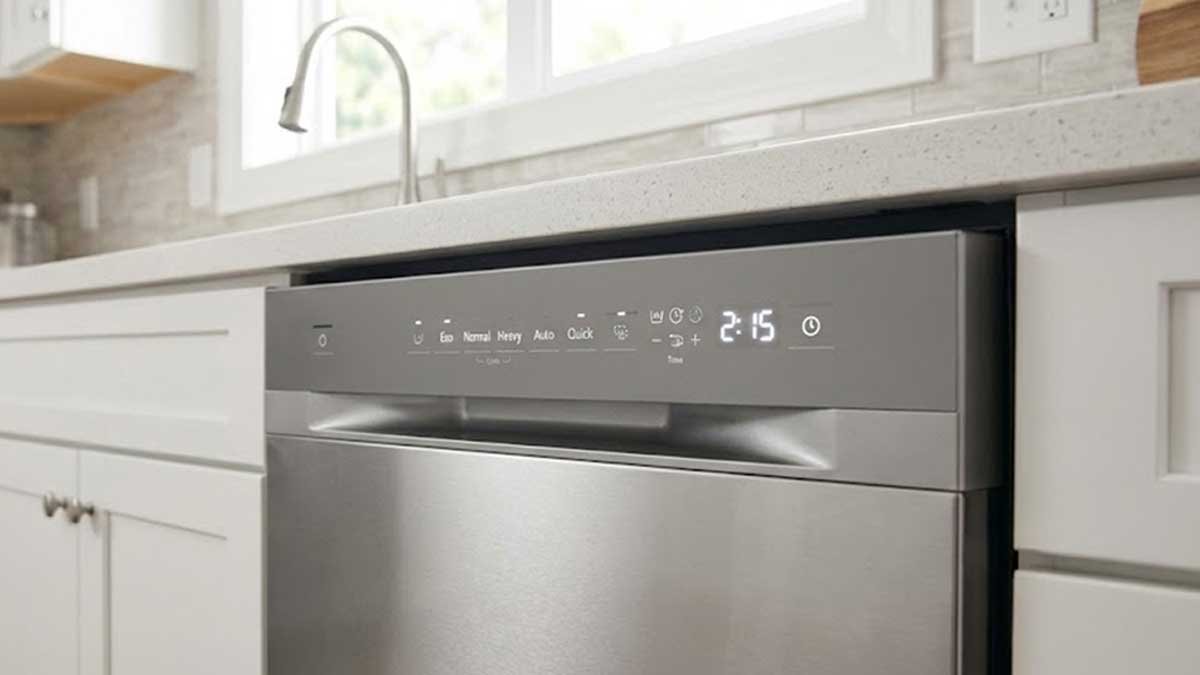
Modern dishwashers look simple on the outside—but the moment you open the control panel, things get confusing fast, making guides like dishwasher cycles explained essential for choosing the right program. Eco, Normal, Auto, Heavy, Quick… every cycle sounds useful, yet most people end up pressing the same button every time and hoping for the best.
The problem is that dishwasher cycles are not just different names for the same wash. Each program changes water temperature, wash pressure, cycle length, and even how your detergent works. Choosing the wrong one doesn’t just affect cleanliness—it can waste energy, leave residue on dishes, or unnecessarily wear out your appliance.
To make sense of all this, it helps to first understand how a dishwasher actually works during a wash cycle, not just what the button says. If you need a deeper technical breakdown, this guide on How Does a Dishwasher Work? explains the full process step by step. Likewise, many cycles are tied directly to specific options and sensors, which we’ve covered in Common Dishwasher Features Explained.
In this article, we’ll break down what each dishwasher cycle really does, why some programs take much longer than others, and—most importantly—when each cycle actually makes sense in real life.
How Dishwasher Cycles Actually Work
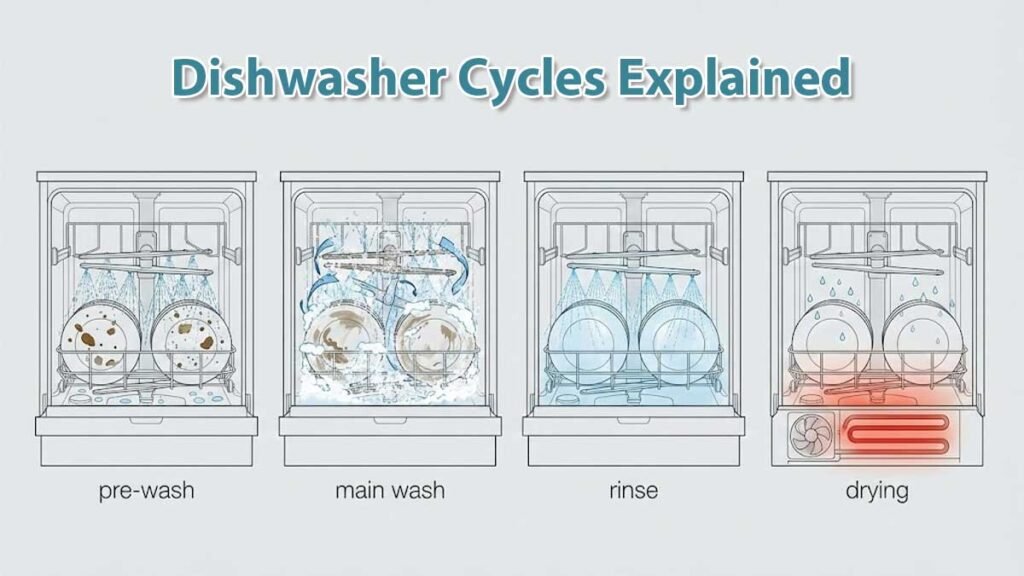
Before comparing cycle names, it’s important to understand what’s happening behind the scenes. While brands use different labels, the core structure of a dishwasher cycle is largely the same across models.
What Happens During a Dishwasher Cycle (Step by Step)
Although it feels like one continuous process, a dishwasher cycle is actually a sequence of carefully controlled stages:
- Pre-wash – The dishwasher sprays water to loosen food particles. In many modern machines, this phase also allows sensors to evaluate how dirty the load is.
- Main wash – Detergent is released, water is heated internally, and spray arms work at full pressure.
- Rinse cycles – One or more rinses remove detergent residue and remaining debris.
- Drying phase – Depending on the cycle, this may involve heated drying, condensation drying, or air drying.
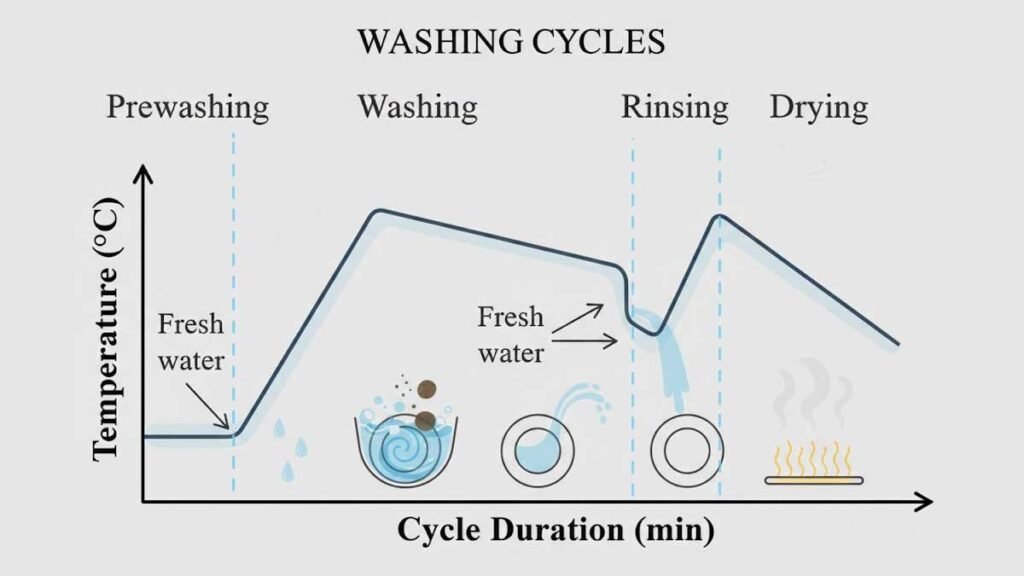
The key point here is that cycle choice determines how long each stage lasts and how aggressively it runs. This is why two cycles can clean the same load very differently.
If you’re curious how dishwasher size, rack spacing, and spray arm coverage affect this process, it’s worth checking Dishwasher Sizes and Dimensions Explained, since physical layout plays a bigger role than most users expect.
Why Dishwasher Cycles Take So Long
One of the most common complaints is cycle length—especially with Eco or Auto programs that can run well over two hours. However, this isn’t poor design; it’s intentional.
Modern dishwashers:
- Heat water internally instead of using household hot water
- Pause to allow enzymes in detergent to work
- Adjust timing based on sensor feedback
- Comply with strict U.S. energy efficiency regulations
As a result, longer cycles often use less electricity and water overall, even though they feel slower. This is explained in more detail in How Energy-Efficient Are Dishwashers?, where we break down why time and energy consumption don’t always correlate the way people expect.
In short, faster isn’t always better—and slower doesn’t mean inefficient.
Common Dishwasher Cycles Explained
Now that we understand how cycles work mechanically, let’s look at the most common dishwasher programs and what they’re actually designed to do.
Normal Cycle – When to Use It
The Normal cycle is the baseline program manufacturers design everything around. It’s tested for average soil levels and is the reference point for energy ratings.
Use it for:
- Everyday plates, bowls, and cutlery
- Mixed loads with light to moderate food residue
- Regular family use
In most households, Normal is the most balanced choice, offering reliable cleaning without excessive energy or water use.
Eco Cycle – What It Really Does
Eco mode is probably the most misunderstood dishwasher cycle. Despite the name, it often runs longer than Normal, which leads many users to assume something is wrong.
In reality:
- Eco uses lower water temperatures
- It compensates with longer wash times
- It reduces total energy consumption over the full cycle
Eco works best when:
- Dishes are not heavily soiled
- You’re running full loads
- Time isn’t a concern
Because it relies heavily on time rather than heat, Eco mode pairs well with modern detergents—but it’s not ideal for baked-on grease or heavily used cookware.
Heavy / Pots & Pans Cycle
This is the most aggressive program your dishwasher offers.
Characteristics include:
- Higher water temperature
- Increased spray pressure
- Extended main wash phase
It’s designed specifically for:
- Pots, pans, and baking dishes
- Thick grease and dried-on food
- Loads that haven’t been pre-rinsed
However, using Heavy for every load is unnecessary and inefficient. Over time, it can increase energy use and stress dishwasher components. Knowing What Not to Put in a Dishwasher is especially important here, since high heat and pressure can damage delicate items.
Quick / Express / 1-Hour Cycle
Quick cycles are built for convenience, not deep cleaning.
They:
- Shorten or skip soaking phases
- Use higher temperatures for a brief time
- Work best on lightly soiled dishes
Quick cycles are ideal when:
- Dishes were just used
- You need clean plates fast
- Appearance matters more than sanitation
They are not suitable for heavy food residue or greasy cookware—and using them daily often leads to poor long-term results.
Auto / Sensor Cycle
Auto cycles rely on turbidity and soil sensors to adjust the wash automatically.
In theory, this sounds perfect. In practice:
- Results vary depending on load placement
- Light loads may still run long
- Heavily soiled loads may trigger extended cycles
Auto works best when:
- You don’t want to think about settings
- Loads are fairly consistent
- You trust the dishwasher’s sensors
It’s a smart option—but not always the most predictable.
Transitional Wrap-Up
At this point, one thing should be clear: dishwasher cycles aren’t interchangeable. Each program is optimized for a specific balance of soil level, time, temperature, and efficiency. Using the right cycle doesn’t just improve cleaning—it saves energy, protects your dishes, and extends the life of your appliance.
Less Common Dishwasher Programs (Explained)
Beyond the main cycles most people recognize, modern dishwashers include several specialized programs. These aren’t marketing gimmicks—they exist to solve very specific problems. The issue is that many users either ignore them completely or use them incorrectly.
Let’s clear that up.
Rinse Only / Pre-Rinse Cycle
The Rinse Only cycle does exactly what the name suggests—and nothing more.
It:
- Uses cold or lightly warmed water
- Runs for a very short time
- Does not use detergent
This cycle is designed for situations where:
- You’re not running a full load yet
- Dishes will sit for several hours or overnight
- You want to prevent odors and dried-on food
However, it’s important to be clear: Rinse Only does not clean dishes. It simply prevents food from hardening and causing problems later. Using it as a substitute for a wash cycle is one of the most common dishwasher mistakes.
Glass / Delicate Cycle
The Glass or Delicate cycle exists for one reason: protection.
Compared to Normal, this cycle:
- Uses lower water temperatures
- Reduces spray pressure
- Shortens aggressive wash phases
It’s ideal for:
- Wine glasses
- Crystal
- Thin glassware and delicate items
That said, it’s not meant for heavy food residue. Mixing fragile glasses with greasy cookware on this cycle almost guarantees poor results—and in some cases, damage.
This is also where knowing What Not to Put in a Dishwasher becomes critical, since some materials simply don’t belong inside, regardless of cycle choice.
Sanitize Cycle (NSF-Certified)
The Sanitize cycle is one of the most misunderstood programs on modern dishwashers.
To meet sanitation standards, the dishwasher must:
- Reach very high water temperatures
- Maintain that temperature for a specific time
As a result, sanitize cycles:
- Use more energy
- Run longer
- Increase internal heat stress
They’re useful when:
- Washing baby bottles
- Cleaning cutting boards
- Handling illness-related hygiene concerns
But for everyday dishwashing, sanitize mode is unnecessary—and often overused.
According to guidance from the U.S. Department of Energy, high-temperature cycles should be reserved for specific needs, not routine washing, due to their increased energy demand.
(External authority link: U.S. Department of Energy – dishwasher efficiency guidance)
Machine Care / Self-Clean Cycle
Some newer dishwashers include a Machine Care or Self-Clean program. This cycle:
- Runs empty
- Uses high temperatures
- Is designed to clean internal components
It should be used:
- Monthly or as recommended by the manufacturer
- With dishwasher cleaner or approved agents
Skipping this cycle doesn’t affect day-to-day cleaning immediately, but over time it contributes to odors, grease buildup, and reduced performance.
Dishwasher Cycle Time Comparison: What the Durations Really Mean
Once users realize that Eco can take three hours while Quick finishes in under one, the next question is inevitable: Why such a huge difference?
The answer lies in how time, temperature, and efficiency interact.
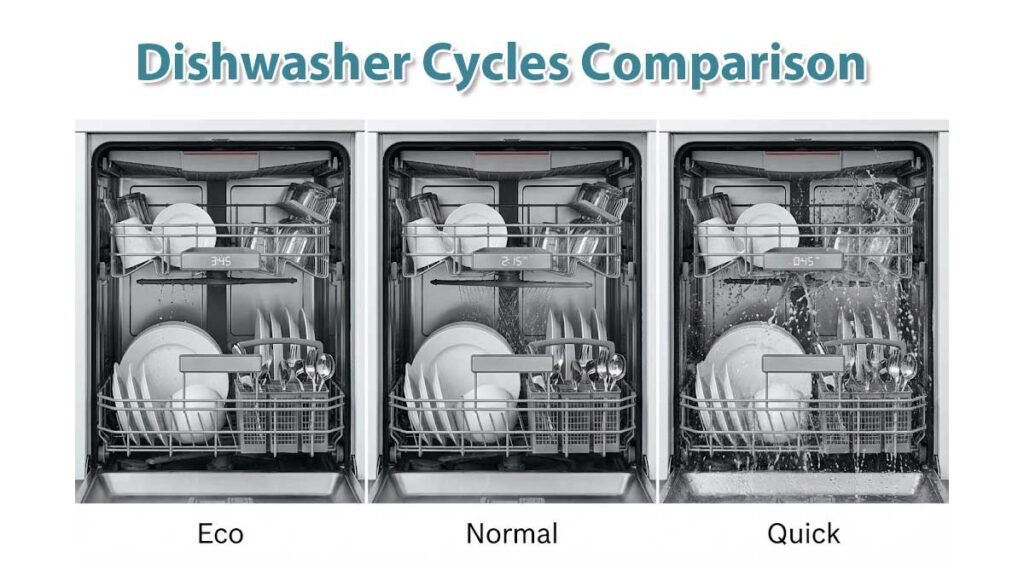
Typical Dishwasher Cycle Lengths (Realistic Ranges)
While exact times vary by brand and model, most dishwashers fall into predictable ranges:
- Quick / Express: ~30–60 minutes
- Normal: ~90–120 minutes
- Eco: ~150–240 minutes
- Auto / Sensor: ~90–180 minutes
- Heavy / Pots & Pans: ~120–180 minutes
- Sanitize (added): +30–45 minutes
What matters here is not speed—but what the dishwasher is doing during that time.
Why Eco Cycles Take the Longest
Eco cycles reduce energy use primarily by:
- Lowering water temperature
- Extending wash and soak phases
Heating water is one of the most energy-intensive parts of dishwashing. By using time instead of heat, Eco cycles dramatically reduce electricity consumption—even though they feel inefficient.
This is why, paradoxically, longer cycles often cost less to run. We cover this relationship in detail in How Energy-Efficient Are Dishwashers?, where cycle duration and energy usage are broken down side by side.
Why Quick Cycles Often Underperform
Quick cycles shorten or eliminate:
- Pre-wash soaking
- Extended detergent contact time
- Multiple rinse stages
They rely almost entirely on:
- Higher initial water temperature
- Light soil conditions
As a result, Quick cycles work best when:
- Dishes are lightly used
- Food hasn’t dried
- You’re prioritizing speed over deep cleaning
Using them daily, especially on mixed loads, is one of the fastest ways to end up with cloudy glasses and lingering residue.
How Cycle Time Relates to Load Size and Layout
Cycle duration doesn’t exist in a vacuum. Dishwasher size, rack spacing, and spray coverage all influence real-world results.
That’s why understanding Dishwasher Sizes and Dimensions Explained is surprisingly relevant here. Larger dishwashers with wider spray coverage often benefit more from longer cycles, while compact models may struggle with overloaded racks—regardless of cycle choice.
Transitional Takeaway
At this stage, a clear pattern emerges: shorter cycles trade thoroughness for speed, while longer cycles trade time for efficiency and consistency. Neither approach is “better” in all situations—the key is matching the cycle to the load.
Which Dishwasher Cycle Should You Use? (Real-Life Scenarios)
By now it should be clear that there is no single “best” dishwasher cycle. The right choice depends on what you’re washing, how dirty it is, and what your priority is—speed, efficiency, or deep cleaning. Let’s translate everything we’ve covered into real, everyday situations.
For Everyday Family Loads
If you’re dealing with:
- plates and bowls from regular meals
- moderate food residue
- mixed loads of glassware and utensils
👉 Normal cycle is your safest and most consistent option.
It provides a balanced combination of temperature, time, and water use, without over-stressing the dishwasher or wasting energy.
For Heavily Soiled Cookware
When you’re washing:
- pots and pans
- baking dishes
- cookware with dried or greasy residue
👉 Heavy / Pots & Pans cycle makes sense.
However, this should be a targeted choice—not a habit. Running Heavy cycles constantly increases energy use and wear on internal components.
For Lightly Used or Recently Rinsed Dishes
If dishes were:
- used briefly
- loaded immediately
- lightly soiled
👉 Quick / Express cycle is appropriate.
Just remember: this cycle prioritizes speed, not depth. It’s perfect for convenience—but not for neglected loads.
For Energy Savings and Full Loads
When your goal is:
- minimizing electricity use
- reducing environmental impact
- running the dishwasher overnight
👉 Eco cycle is the right call.
Although it takes longer, Eco is designed to be the most efficient option overall. This is where understanding How Energy-Efficient Are Dishwashers? really pays off, since longer runtime does not equal higher energy cost.
For Baby Bottles and Hygiene-Sensitive Items
If hygiene is a concern:
- baby bottles
- cutting boards
- items used during illness
👉 Sanitize cycle is useful—but only when needed.
Using it daily provides no real benefit and only increases energy consumption.
Transitional Insight
In other words, the “best” dishwasher cycle is simply the one that matches the job at hand. Choosing cycles deliberately—rather than automatically—leads to cleaner dishes, lower energy use, and longer appliance life.
Common Dishwasher Cycle Mistakes to Avoid
Even the best dishwasher can underperform if cycles are used incorrectly. Over time, these mistakes add up—leading to poor cleaning, higher bills, and unnecessary frustration.
Overusing the Quick Cycle
Quick cycles are convenient, which is exactly why they’re overused.
The problem is that:
- they shorten detergent contact time
- they reduce soaking and rinsing
- they don’t handle mixed soil levels well
Using Quick daily often leads to residue buildup and cloudy glassware.
Avoiding Eco Mode Without a Good Reason
Many users skip Eco because it “takes too long.” In reality, Eco mode is one of the most misunderstood features on modern dishwashers.
Avoiding it:
- increases long-term energy use
- defeats the purpose of efficient appliance design
When time allows, Eco is often the smartest choice.
Running Heavy Cycles Too Often
Heavy cycles are powerful—but that power comes at a cost.
Frequent use can:
- waste water and electricity
- stress heating elements
- shorten dishwasher lifespan
Reserve Heavy for truly dirty loads, not everyday dishes.
Choosing Cycles Based Only on Time
This is one of the biggest mindset issues.
Shorter cycles aren’t “better”—they’re simply less thorough. Selecting a cycle should be based on soil level, not how fast you want the dishwasher to finish.
Ignoring Load Type and Item Safety
Some cleaning issues aren’t cycle-related at all—they’re loading mistakes.
Knowing What Not to Put in a Dishwasher helps prevent:
- damaged cookware
- warped plastics
- poor cleaning performance
Even the right cycle can’t compensate for the wrong items.
Frequently Asked Questions About Dishwasher Cycles
Which dishwasher cycle uses the least electricity?
The Eco cycle typically uses the least electricity. Even though it runs longer, it relies on lower water temperatures and longer soaking phases instead of energy-intensive heating.
Is Eco mode really better than the Normal cycle?
Yes, in terms of energy efficiency. Eco mode is designed to minimize electricity and water use, while Normal mode offers a better balance between time and performance for everyday loads.
Why does my dishwasher Eco cycle take 3 hours or more?
Eco cycles take longer because they use time instead of heat to clean dishes. Lower temperatures require longer wash phases to allow detergents and enzymes to work effectively.
Can I use the Quick dishwasher cycle every day?
Quick cycles are best for lightly soiled dishes only. Using them daily on mixed or dirty loads often leads to residue buildup and poor cleaning results over time.
Does dishwasher cycle choice affect drying performance?
Yes. Longer cycles like Normal, Eco, and Heavy typically result in better drying, while Quick cycles often leave dishes damp due to shortened drying phases.
Is the Auto cycle better than choosing a cycle manually?
Auto cycles can be convenient, but results vary depending on sensor accuracy and load placement. For consistent results, manually selecting the appropriate cycle based on soil level is often more reliable.
Does using the wrong cycle damage my dishwasher?
Occasional misuse won’t cause immediate damage, but frequent overuse of Heavy or Sanitize cycles can increase wear on heating elements and internal components over time.
Final Transition Before Conclusion
Once you stop treating dishwasher cycles as interchangeable buttons and start seeing them as purpose-built programs, everything changes. Cleaning improves, energy use drops, and the dishwasher simply works the way it was designed to.
Final Takeaway (TL;DR – Featured Snippet Friendly)
- Dishwasher cycles are designed for specific cleaning scenarios
- Eco cycles run longer but usually use less energy
- Normal is the best everyday choice for most homes
- Quick cycles prioritize speed, not deep cleaning
- Heavy and Sanitize should be used only when necessary
Choosing the right cycle isn’t about memorizing settings—it’s about understanding what your dishwasher is actually doing.