



If you’ve ever trained consistently, watched what you eat, and still felt stuck — you’re not alone.
Over the years, I’ve seen countless people do “everything right” on paper and still struggle with energy, fat loss, or long-term progress. The problem usually isn’t effort. It’s fragmentation.
Most health advice treats fitness, nutrition, sleep, and weight loss as separate goals. Train harder here. Eat less there. Sleep when you can. Track the scale and hope it moves. In real life, that approach rarely works — especially once work stress, family, and limited time enter the picture.
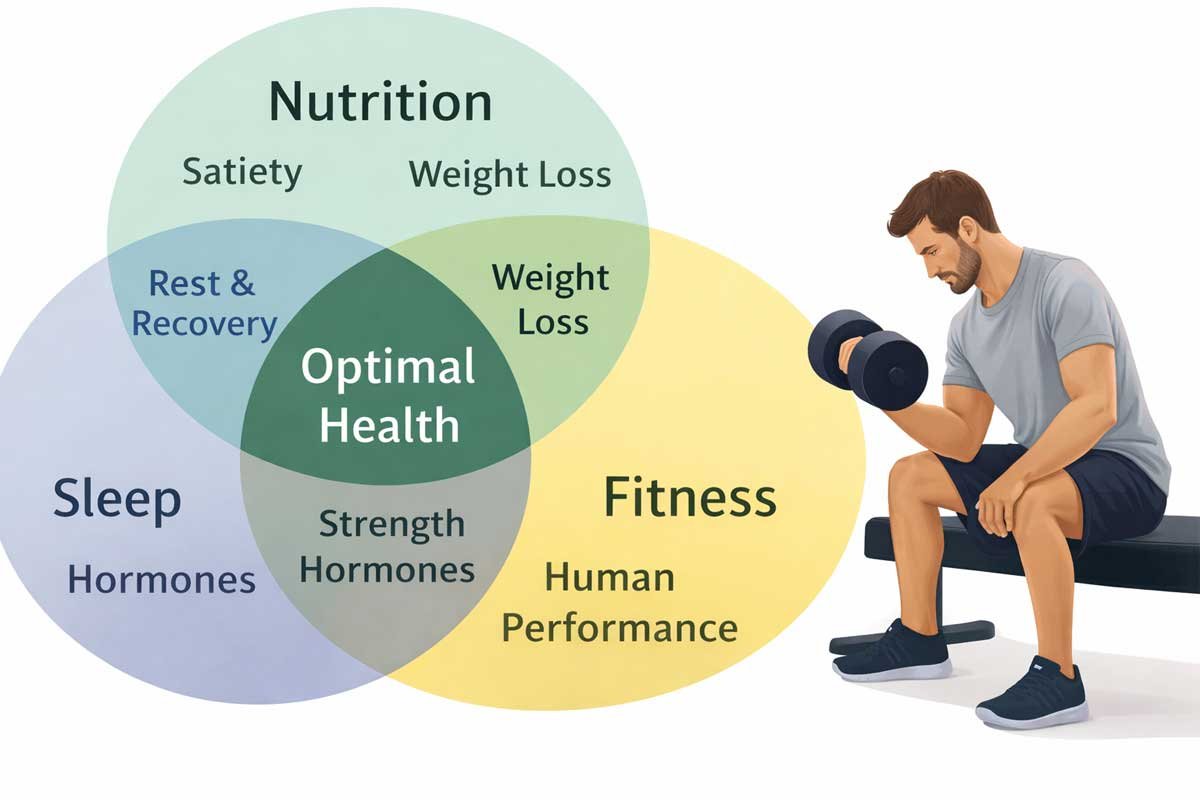
What does work is thinking in systems. When training supports recovery, food supports performance, sleep regulates hormones, and weight loss becomes a by-product, not a battle — everything changes. That’s what I call the Real Health Stack. And once you understand how the pieces fit together, health stops feeling complicated.
Why Most People Struggle With Health (Even When They’re “Doing Everything Right”)
I’ve tested home gym gear, followed structured programs, tracked nutrition, and coached people who were deeply motivated. The pattern is always the same: progress stalls when one pillar quietly undermines the others.
The Problem With Isolated Efforts
Here’s a common scenario I see all the time:
- You train hard, 5–6 days a week
- You cut calories aggressively
- You sleep 5–6 hours because life is busy
On paper, that looks disciplined. In reality, it’s a setup for frustration.
Heavy training without enough sleep raises stress hormones. Low calories without recovery increase cravings. Poor sleep wrecks insulin sensitivity. Suddenly fat loss slows, motivation drops, and people blame willpower — when the real issue is conflict inside the system.
Health doesn’t fail because people are lazy. It fails because the inputs are fighting each other.
Health Is a System, Not a Checklist
Think of your body like a simple control panel, not a set of independent switches. When one lever is pulled too hard, the others compensate — often in ways you don’t notice right away.
I’ve learned this the hard way myself. Periods where I trained intensely but ignored sleep always led to stalled results. When I fixed sleep first, training suddenly felt easier and nutrition became more intuitive. Same workouts. Same food. Different outcome.
That’s the core lesson:
progress happens when the system is aligned, not when one habit is extreme.
The Real Health Stack Explained (Think System, Not Hacks)
The word “stack” gets thrown around a lot, usually tied to supplements or shortcuts. That’s not what this is. The Real Health Stack is about how behaviors compound — for better or worse.
What “Stack” Really Means in Real Life
In practice, a health stack is simple:
- Training creates stimulus
- Nutrition fuels and repairs
- Sleep regulates hormones and recovery
- Weight loss reflects how well those three cooperate
When one element is weak, the entire stack wobbles. When all four support each other, progress feels almost boring — and that’s a good thing.
This is why two people can follow the same workout plan and get completely different results. One is stacking habits. The other is stacking stress.
I’ve personally gone through phases where training more felt like the responsible thing to do. Six days a week, minimal rest, constant soreness — and surprisingly little progress. What finally moved the needle wasn’t another workout. It was pulling back just enough to recover. Strength went up, cravings went down, and fat loss resumed without forcing it.
Why Consistency Beats Intensity Every Time
I’ve tested intense programs. They work — briefly. Then life happens.
What holds up long-term isn’t motivation or perfect plans. It’s repeatable behavior. Moderate training you can recover from. Nutrition that doesn’t require white-knuckling. Sleep routines that fit real schedules.
When the stack is built around consistency, results don’t spike — they accumulate. And that’s exactly what sustainable health looks like.
Fitness — Train to Support Fat Loss, Not Fight It
One of the biggest mistakes I see is treating training as punishment for eating. More workouts. More sweat. Less rest. It feels productive — until it stops working.
Training should support fat loss, not compete with it. When workouts are too frequent or too intense for your recovery capacity, the body adapts defensively. Performance drops, appetite rises, and fat loss slows down — even if calories are low.
If you’re building strength at home, the right setup matters far more than volume. We’ve broken down the most practical options — from space-saving basics to scalable systems — in our Best Home Gym Equipment for Beginners guide.
Why More Workouts Don’t Equal Better Results
I’ve tested this personally and seen it repeatedly in others. Pushing volume without recovery leads to:
- chronic soreness that never fully clears
- declining strength despite “working harder”
- stubborn fat that refuses to move
This isn’t a lack of discipline. It’s a recovery mismatch. Fat loss thrives in a body that feels safe, not constantly stressed.
Three to four well-structured sessions per week, done consistently, almost always outperform chaotic daily workouts in the long run.
Strength Training as the Foundation
If fat loss is your goal, strength training isn’t optional — it’s foundational.
Lifting weights preserves muscle, improves insulin sensitivity, and keeps metabolism from adapting downward too aggressively. That’s especially important once you’re past your twenties.
From real-world use, I’ve found that simple, compound-focused routines work best:
- presses
- rows
- squats or hinges
- carries
You don’t need complexity. You need progression you can recover from.
Cardio’s Real Role (And Where Most People Get It Wrong)
Cardio isn’t the enemy — misuse is.
Low- to moderate-intensity cardio supports recovery, improves conditioning, and helps manage stress. High-intensity cardio layered on top of heavy training and low calories is where problems start.
The sweet spot?
Use cardio as a tool, not a test. If it leaves you energized rather than drained, it’s probably helping the stack.
Nutrition — Fuel, Don’t Punish, Your Body
Nutrition is where most people become extreme — and extremes rarely last.
I’ve seen people slash calories, eliminate entire food groups, and still feel confused when results fade. The issue isn’t effort. It’s sustainability.
Food should support training and recovery, not create another stress signal.
Calories Matter, But Hormones Decide the Outcome
Yes, calories matter. But hormones decide how those calories are used.
Poor sleep, high stress, and excessive training elevate cortisol. Elevated cortisol makes fat loss harder and cravings stronger — even in a calorie deficit.
This is why two people eating the same amount can experience completely different results. Context matters.
Protein, Fiber, and Timing (The 80/20 That Works)
If I had to simplify nutrition for most people, it would come down to three priorities:
- adequate protein to support muscle and satiety
- fiber-rich foods for appetite control and gut health
- meal timing that doesn’t fight your daily schedule
You don’t need perfect macros. You need predictable habits that don’t require constant willpower.
From experience, people who eat enough protein and sleep well rarely struggle with hunger the way chronic dieters do.
Why Extreme Diets Break the Health Stack
Extreme diets work fast — and fail faster.
They increase stress, reduce training performance, and often damage your relationship with food. When the diet ends, weight returns — usually with interest.
Sustainable fat loss isn’t about restriction. It’s about alignment. When nutrition fuels training and sleep supports recovery, appetite naturally regulates. That’s when weight loss becomes calm instead of chaotic.
One thing I’ve noticed consistently — both in my own routine and in people I’ve coached — is that hunger becomes far less dramatic when protein and sleep are dialed in. When those two are off, no amount of calorie tracking feels sustainable. Fix them, and nutrition almost takes care of itself.
Sleep — The Silent Driver of Fat Loss and Recovery
Sleep is the least glamorous part of the health stack — and the most underestimated.
People will buy better gear, plan meals, track macros, and still treat sleep as optional. Then they wonder why nothing sticks.
From years of testing routines and watching patterns play out, I can say this with confidence: poor sleep quietly undermines everything else. You can train well and eat “clean,” but if sleep is broken, progress slows behind the scenes.

Research consistently shows that sleep deprivation disrupts hormonal balance, appetite regulation, and metabolic health, making fat loss significantly harder over time — a relationship well documented by the National Institutes of Health.
How Poor Sleep Sabotages Training and Diet
When sleep quality drops, recovery takes the hit first. Muscles don’t repair as efficiently, joints feel stiff longer, and workouts that used to feel manageable start feeling heavy.
At the same time, appetite regulation shifts. Cravings increase. Energy dips. Motivation becomes unreliable. This isn’t a character flaw — it’s physiology responding to fatigue.
I’ve seen people improve fat loss simply by sleeping more consistently, without changing training or calories. That alone should tell you how powerful this lever is.
Sleep Quality vs. Sleep Quantity
More hours don’t always mean better sleep. What matters just as much is consistency and depth.
Going to bed at wildly different times, staring at screens late into the night, or carrying stress straight into bed all reduce sleep quality — even if total hours look decent on paper.
In real life, the goal isn’t perfection. It’s predictability. A body that knows when rest is coming recovers better and performs better.
Simple Sleep Upgrades That Actually Work
You don’t need biohacking gadgets or complicated routines. The upgrades that consistently help are boring — and effective:
- a regular wind-down window before bed
- reducing bright light late at night
- keeping the bedroom cool and quiet
- training earlier in the day when possible
These changes don’t look impressive on social media, but they quietly strengthen the entire stack.
Weight Loss — The Result, Not the Goal
This is where most health plans go wrong: they make weight loss the target instead of the outcome.
Chasing the scale creates urgency. Urgency creates shortcuts. Shortcuts create rebound.
From everything I’ve observed — in my own routines and in others — weight loss works best when it’s treated as feedback, not a command.
Why Chasing the Scale Backfires
Daily weigh-ins, aggressive deficits, and constant adjustments keep the body in a reactive state. Small fluctuations feel like failure. Progress becomes emotional instead of logical.
The irony is that this approach often slows fat loss over time. Stress rises. Recovery suffers. Consistency breaks.
When weight becomes the only metric, people miss what actually drives change.
Fat Loss as a Side Effect of a Balanced Stack
When training is appropriate, nutrition is supportive, and sleep is consistent, fat loss tends to happen quietly. There’s less urgency. Less forcing. Fewer extremes.
That’s not exciting — but it’s sustainable.
I’ve seen the best long-term results come from people who stopped “trying to lose weight” and focused instead on building a system they could live with. The scale followed, not the other way around.
How to Build Your Own Health Stack (Step-by-Step)
Once people understand the system, the next question is always the same: Where do I start?
The mistake is trying to fix everything at once. The smarter move is to strengthen the weakest link first.
Start With the Weakest Link
In real life, one pillar is almost always lagging behind the others. For some, it’s sleep. For others, nutrition consistency. Sometimes it’s training volume that doesn’t match recovery.
The fastest progress comes from asking one honest question:
Which part of my stack is currently making everything harder?
Fixing that first creates momentum. Energy improves. Decisions get easier. Motivation stops feeling forced.
Build Simple Before You Build Perfect
I’ve tested complex setups and minimalist ones. The simpler systems always win long-term.
A basic training plan you can repeat beats an advanced one you abandon.
A few reliable meals beat endless macro tweaks.
A realistic sleep routine beats chasing eight “perfect” hours.
Simplicity isn’t a compromise — it’s a strategy.
Adjust the Stack as Your Life Changes
Your health stack at 25 won’t look the same at 35 or 45. Work stress, family responsibilities, injuries, and energy levels all shift the equation.
What matters is adaptability.
When life gets heavier, the stack should get simpler, not stricter. People who succeed long-term aren’t more disciplined — they’re more flexible.
Common Health Stack Mistakes I See All the Time
These mistakes don’t come from ignorance. They come from good intentions applied in the wrong order.
Buying Gear Before Building Habits
Gear can help — but only after habits exist.
I’ve seen fully equipped home gyms collecting dust while basic routines never took root. Equipment should support behavior, not replace it.
When habits come first, even minimal setups deliver results.
Copying Influencers Instead of Listening to Your Body
Online routines are optimized for views, not for your schedule, sleep, or stress levels.
What works for someone training full-time with perfect recovery doesn’t automatically work for someone balancing work, family, and limited rest. Your body gives feedback every day — if you pay attention to it.
Ignoring Recovery Until Something Breaks
Recovery is usually addressed only after pain, burnout, or complete loss of motivation. By then, the stack has already collapsed.
Recovery isn’t passive. It’s an active part of training. When it’s respected early, progress stays smooth instead of dramatic.
Final Thoughts — Build a System You Can Live With
Health doesn’t need to feel like a constant project. When fitness, nutrition, sleep, and weight loss are treated as a single system, the noise fades and decisions become simpler.
You stop chasing quick wins and start building momentum. Training becomes something you do because it supports your life, not because you’re trying to “fix” yourself. Food becomes fuel again. Sleep stops being negotiable. And weight loss, when it happens, feels steady rather than stressful.
Over the years, the most successful people I’ve seen weren’t the most disciplined or extreme. They were the ones who built a system they could return to — even after setbacks. That’s the real goal. Not perfection, but reliability.
Health That Fits Your Life Always Wins
The best health stack is the one that survives busy weeks, imperfect days, and changing priorities. It adapts instead of collapsing. It supports you instead of demanding more than you can give.
If you take one thing from this article, let it be this:
progress follows alignment, not pressure.
Build your stack slowly. Strengthen the weakest link first. And trust that when the system works together, results take care of themselves.
Smart Tip Before You Start
Don’t try to optimize everything this week. Pick one small improvement you can repeat — an earlier bedtime, a simpler workout schedule, or a more balanced meal. Let that win compound.
Health isn’t built in sprints.
It’s built in systems you can live with.
health stack
,
fitness after 30